
Productscpzx


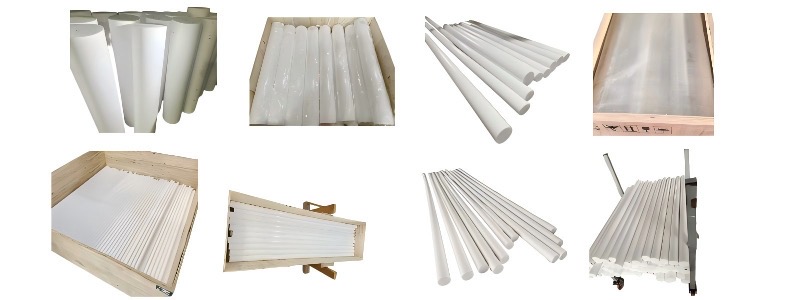
PTFE Extruded/Molded Rod/Filled Rod
Ⅰ、Features
Diameter 4-9mm rod selection of dispersed polymerization of PTFE resin paste made by extrusion processing; Diameter 10-150mm rods made of PTFE resin suspension made by plunger processing; diameter of 150mm or more by the mold Made of processing. For filled PTFE rods,can be filled glassfiber,graphite,carbon with different percent,10%,15%,25% and so on.
Ⅱ、Types and Specifications

Ⅲ、Main Properties

Note: When the diameter of rod is larger than 16mm,only test apparent density.
Ⅳ、Applications
Electrical insulation parts, seal pads, anti-sticking materials
PTFE Extruded Rod Product Introduction
PTFE extruded rod is a high-performance plastic rod made from pure polytetrafluoroethylene (PTFE) as the raw material, formed through a ram extrusion process. As a premium category within PTFE products, it leverages a unique continuous extrusion manufacturing process that retains PTFE's excellent chemical stability while offering superior mechanical properties and dimensional accuracy, making it an ideal choice for demanding industrial environments.
Core Product Advantages
· Denser Structure: Porosity below 0.5%, providing 3 times better airtightness compared to molded products.
· Outstanding Mechanical Properties: Tensile strength reaches 35 MPa, elongation at break exceeds 500%.
· Ultra-Long Continuous Forming: Supports unlimited length coil supply (maximum diameter 300mm).
· Zero Surface Defects: Inner wall smoothness Ra < 0.4 μm, meeting medical-grade requirements.
· Higher Cost-Effectiveness: Material utilization increased by 30%, production costs reduced by 25%.
Key Performance Parameters
· Temperature Range: -200℃ ~ +260℃ (short-term 300℃)
· Dielectric Strength: 45 kV/mm (1mm thickness)
· Friction Coefficient: 0.05-0.08 (water-lubricated conditions)
· Coefficient of Linear Expansion: 9.5×10⁻⁵/℃ (20-100℃)
Typical Application Fields
· Chemical Corrosion Protection: Reactor linings, pipeline compensators.
· Cable Manufacturing: Insulation layer for high-frequency communication cables.
· Medical Devices: Minimally invasive surgical catheters, artificial blood vessels.
· Semiconductor: Ultra-pure chemical delivery pipelines.
· Food Industry: Lining for dairy processing pipelines.
Special Customization Capabilities
· Flexible Sizes: Adjustable diameter from 0.5-300mm, minimum wall thickness 0.3mm.
· Functional Modification: Special types available (conductive/anti-static/reinforced).
· Color Variety: Standard white, optional black, gray, blue, etc., for identification.
· Comprehensive Certifications: Passed FDA, NSF, RoHS, and other international certifications.
Technical Service Support
· Provision of ANSYS mechanical simulation reports.
· Free sample cutting service (≤ 1 meter).
· On-site installation guidance (e.g., flange sealing solutions).
· Failure analysis and improvement suggestions.
This product has been successfully applied in:
· 98% sulfuric acid transfer system in a chemical group (5 years of continuous use without corrosion).
· High-frequency coaxial cables for 5G base stations (dielectric loss < 0.0003).
· DSA interventional therapy catheters in a tertiary hospital (passed ISO 10993 testing).
Note: Medical-grade products require raw materials from dedicated clean production lines. Conventional industrial grade is not recommended for direct human contact scenarios. Accelerated aging tests are recommended for validation under extreme conditions.
Basic Characteristics
Item
Parameter
Test Standard
Material Composition
Pure Polytetrafluoroethylene (PTFE)
-
Production Process
Ram Extrusion Molding
ASTM D4894
Color
White (Black/Gray, etc. customizable)
Visual
Density
2.14-2.20 g/cm³
ASTM D792
Continuous Service Temperature
-200℃ ~ +260℃
ASTM D794
Core Performance Data
Performance Indicator
Value Range
Difference vs. Molded Rod
Tensile Strength
25-35 MPa
10-15% Higher
Elongation at Break
300-500%
50-100% Higher
Dielectric Strength
40-50 kV/mm
Similar
Friction Coefficient (Dynamic)
0.05-0.10
20% Lower
Linear Shrinkage (after sintering)
3-5%
More Stable
Extrusion Process Advantages
1. Structural Density
· Porosity < 0.5% (Typically 1-2% for molded rods)
· Permeation resistance improved by 3 times (ASTM F37 airtightness test)
2. Dimensional Capabilities
| Parameter | Extrusion Process | Molding Process |
| Maximum Diameter | 300mm | 150mm |
| Length Continuity | Unlimited Length (Coiled) | ≤ 1200mm |
| Wall Thickness Uniformity | ± 0.05mm | ± 0.1mm |
3. Economic Comparison
· Material utilization rate increased by 20-30%
· Production speed reaches 2-5 m/min (Molding method: 0.5 m/min)
Product Specification Table
Specification Parameter
Standard Range
Special Customization
Diameter
5-250mm
0.5-300mm
Wall Thickness (Tubing)
1-50mm
0.3-100mm
Length
Coiled (Max 500m)
Fixed-length cutting
Tolerance
± 0.1% (Diameter)
± 0.05% (Precision Grade)
Key Application Fields
Application Scenario
Advantage Demonstrated
Typical Product
Chemical Pipeline Lining
Weld-free, Anti-permeation
Flange liner, Compensator
Cable Sheath
Ultra-long Continuous Extrusion
High-frequency cable insulation layer
Medical Catheters
Inner Wall Smoothness Ra < 0.4 μm
Minimally invasive surgical instrument sleeve
Semiconductor Transport
Ultra-pure, Non-leaching
Acid delivery tube
Certification System
Certification Type
Applicable Standard
Inspection Focus
Food Grade
FDA 21 CFR 177.1550
Total Migration < 10 mg/dm²
Electronic Grade
SEMI F57
Metal Ion Content < 1 ppb
Industrial Anti-corrosion
NACE MR0175/ISO 15156
H₂S Stress Corrosion Test
EU Environmental
RoHS/REACH
PFOA < 25 ppb
Selection Considerations
· Scenarios for Cautious Use:
· ❌ Long-term exposure to temperatures > 260°C
· ❌ Contact with molten alkali metals
· Recommended Scenarios:
· ✅ Transporting highly corrosive media
· ✅ Applications requiring high cleanliness levels


