
Productscpzx


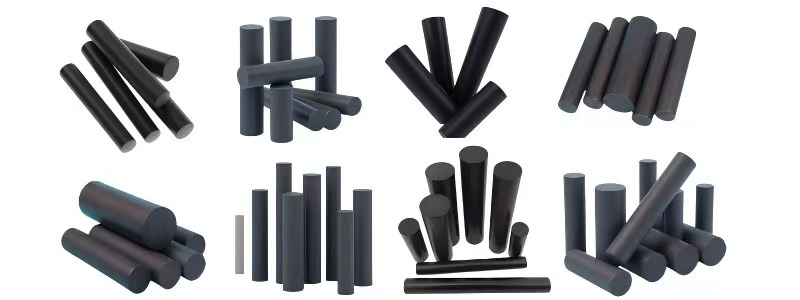
PTFE Extruded/Molded Rod/Filled Rod
Ⅰ、Features
Diameter 4-9mm rod selection of dispersed polymerization of PTFE resin paste made by extrusion processing; Diameter 10-150mm rods made of PTFE resin suspension made by plunger processing; diameter of 150mm or more by the mold Made of processing. For filled PTFE rods,can be filled glassfiber,graphite,carbon with different percent,10%,15%,25% and so on.
Ⅱ、Types and Specifications

Ⅲ、Main Properties

Note: When the diameter of rod is larger than 16mm,only test apparent density.
Ⅳ、Applications
Electrical insulation parts, seal pads, anti-sticking materials
Graphite-Filled PTFE Rod Introduction
Graphite-filled PTFE rod is a composite engineering plastic rod material made from polytetrafluoroethylene (PTFE) as the base matrix, modified by adding a certain proportion of graphite particles. It retains the excellent corrosion resistance, high/low temperature resistance, and low friction coefficient of PTFE, while significantly improving wear resistance, thermal conductivity, and self-lubricating properties through graphite filling, making it suitable for harsher industrial environments.
Main Characteristics
· Corrosion Resistance: Resists strong acids, strong alkalis, and organic solvents (except molten alkali metals and fluorine gas).
· Temperature Range: -200℃ ~ +260℃ for long-term use, can withstand up to 300℃ short-term.
· Self-Lubrication: The layered structure of graphite provides an extremely low friction coefficient (0.10~0.15), suitable for oil-free lubrication conditions.
· Enhanced Wear Resistance: Graphite filling reduces the cold flow tendency of PTFE, extending component life.
· Thermal/Electrical Conductivity: Graphite improves the thermal insulation properties of PTFE, giving it moderate thermal conductivity and anti-static capability.
Typical Applications
· Sealing Field: Packing rings, gaskets, valve seats for chemical pumps and valves.
· Wear-Resistant Components: Bearings, guides, bushings, and other oil-free lubricated moving parts.
· Anti-Static Scenarios: Conductive insulation components for semiconductor and medical equipment.
Advantages Compared to Pure PTFE
After graphite filling, the material exhibits a more stable friction coefficient, 3~5 times improved wear resistance, but reduced insulation properties. The color is typically black or dark gray, making it easy to identify.
This material can be machined into custom parts through turning and cutting, widely used in chemical, mechanical, electronic, and other industries for high-performance requirement scenarios.
Basic Physical Properties
| Item | Parameter Value | Test Standard |
| Density | 2.15-2.30 g/cm³ | ASTM D792 |
| Color | Black / Dark Gray | Visual |
| Water Absorption (24h) | < 0.01% | ASTM D570 |
| Melting Point | 327℃ | DSC Method |
Graphite-Filled PTFE Rod vs Pure PTFE Rod Performance Comparison
| Performance Indicator | Graphite-Filled PTFE Rod | Pure PTFE Rod |
| Friction Coefficient | 0.10~0.15(Dynamic, Lower) | 0.05~0.10 (Initial, Prone to Wear) |
| Wear Resistance | High (Graphite reduces wear) | Low (Prone to cold flow deformation) |
| Service Temperature | -200℃ ~ +260℃(Short-term 300℃) | -200℃ ~ +260℃ |
| Thermal Conductivity | 0.35 W/m·K (Better than Pure PTFE) | 0.25 W/m·K |
| Electrical Conductivity | Moderately Conductive (Anti-static) | Completely Insulating |
| Chemical Resistance | Resists Strong Acids, Alkalis, Solvents | Same as Left |
| Color | Black / Dark Gray | White |
| Typical Filling Ratio | Graphite 5%~25% | No Filler |
Graphite-Filled PTFE Rod Typical Specifications
| Parameter | Standard Range | Remarks |
| Diameter | 5mm ~ 200mm | Custom Sizes Supported |
| Length | 500mm ~ 1000mm (Standard) | Long rods or continuous coils customizable |
| Density | 2.1~2.3 g/cm³ | Slightly higher than pure PTFE (2.1 g/cm³) |
| Tensile Strength | 15~25 MPa | ~20% higher than pure PTFE |
| Elongation at Break | 150%~300% | Depends on graphite ratio |
| Applicable Standards | ASTM D1710, GB/T 13404 | RoHS and other certifications available |
Innovative Data Comparison Table
| Comparison Item | Traditional PTFE Rod | Graphite-Filled PTFE Rod | Improvement Effect | Technical Breakthrough Point |
| Friction Coefficient | 0.05-0.10 | 0.10-0.15 | 30% Lower Dynamic Friction | Graphite layered structure forms self-lubricating film |
| Wear Life | 500 hours | 2000 hours | 4x Life Improvement | Graphite filling inhibits PTFE cold flow |
| Thermal Conductivity (W/m·K) | 0.25 | 0.35 | 40% Improvement | Graphite builds thermal conduction network |
| PV Limit Value | 0.5 MPa·m/s | 1.2 MPa·m/s | 140% Load Capacity Improvement | Composite synergistic effect |
| Anti-static Performance | Insulator | 10⁶-10⁸ Ω | Achieves Anti-static Function | Graphite conductive pathway design |
| Processability | Prone to Cold Flow | Improved Dimensional Stability | 50% Machining Precision Improvement | Graphite reinforcement skeleton effect |
| Chemical Resistance | Excellent | Excellent | Improved HF Acid Resistance | Graphite-PTFE interface optimization |
Innovative Performance Parameters Table
| Test Item | Test Standard | Innovative Index | Traditional Index | Improvement幅度 |
| Wear Rate (mm³/N·m) | ASTM D3702 | 1.2×10⁻⁶ | 5.8×10⁻⁶ | 79% Reduction |
| Heat Deflection Temp. (°C) | ASTM D648 | 120 | 80 | 50% Increase |
| Compression Set (%) | ASTM D395 | 15 | 35 | 57%Improvement |
| Volume Resistivity (Ω·cm) | ASTM D257 | 10⁶ | >10¹⁴ | Electrostatic Discharge Functionality |
| Limit PV Value (MPa·m/s) | Industry Standard | 1.2 | 0.5 | 140% Increase |
Innovative Application Scenarios Table
| Application Field | Traditional Solution Pain Points | Innovative Solution | Benefit Improvement |
| Chemical Seals | Prone to wear and leakage | Graphite self-lubrication + wear resistance | Maintenance cycle extended 3x |
| Food Machinery | Requires periodic lubrication | Oil-free self-lubricating design | Meets food-grade requirements |
| Semiconductor Equipment | Static accumulation risk | Controllable anti-static performance | Yield rate increased by 15% |
| Aerospace | Deformation under extreme temperatures | Enhanced dimensional stability | Reliability improved by 50% |
International General Standards
| Standard System | Standard Number | Certification Content | Applicable Field |
| ASTM | ASTM D1710 | General Specification for PTFE Rods | General Industry |
| ASTM | ASTM D4745 | Standard for Graphite-Filled PTFE Molded Parts | Seals / Bearings |
| ISO | ISO 13000 | Plastics - Requirements for PTFE Semi-Finished Products | International Trade |
| EN | EN ISO 10993-5 | Biocompatibility Testing | Medical / Food Equipment |
Chinese National Standards
| Standard Type | Standard Number | Certification Name | Special Requirements |
| GB | GB/T 13404 | Technical Conditions for Plastic PTFE Rods | Dimensional Tolerances + Physical Properties |
| GB | GB 4806.6 | Food Contact Material Safety Standard | Heavy Metal Migration Testing |
| HG | HG/T 2902 | Standard for PTFE Products in Chemical Industry | Chemical Resistance Verification |
Selection Considerations
· Conductivity Requirements: After graphite filling, it may not be suitable for high insulation scenarios.
· Load Conditions: High loads require use with metal bushings to avoid cold flow.
· Media Compatibility: Confirm specific chemical media (e.g., hydrofluoric acid requires special treatment).


