
Productscpzx


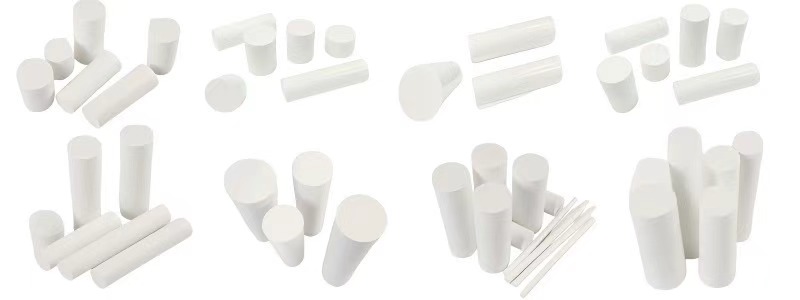
PTFE Extruded/Molded Rod/Filled Rod
Ⅰ、Features
Diameter 4-9mm rod selection of dispersed polymerization of PTFE resin paste made by extrusion processing; Diameter 10-150mm rods made of PTFE resin suspension made by plunger processing; diameter of 150mm or more by the mold Made of processing. For filled PTFE rods,can be filled glassfiber,graphite,carbon with different percent,10%,15%,25% and so on.
Ⅱ、Types and Specifications

Ⅲ、Main Properties

Note: When the diameter of rod is larger than 16mm,only test apparent density.
Ⅳ、Applications
Electrical insulation parts, seal pads, anti-sticking materials
Glass Fiber-Filled PTFE Rod Product Introduction
Glass fiber-filled PTFE rod is a high-performance engineering plastic product made from polytetrafluoroethylene (PTFE) as the base material, reinforced with glass fibers through a special process. This product perfectly combines the excellent properties of PTFE with the reinforcing effect of glass fibers. While retaining outstanding chemical stability, it significantly improves mechanical strength and wear resistance, making it an ideal choice for demanding working conditions.
Core Advantages
· High Strength & Pressure Resistance: The addition of glass fibers increases compressive strength to 2-3 times that of pure PTFE, up to 60 MPa.
· Exceptional Wear Resistance: Wear rate as low as 0.8×10⁻⁶ mm³/N·m, service life extended by 5-8 times.
· Dimensional Stability: Coefficient of linear expansion reduced by 30%, heat deflection temperature up to 150°C.
· Maintains Chemical Inertness: Retains PTFE's resistance to strong acids and alkalis (e.g., concentrated sulfuric acid, hydrofluoric acid).
Typical Applications
· Heavy-Duty Seals: High-pressure pump/valve seals, compressor piston rings.
· Wear-Resistant Components: Chemical equipment linings, bearing guides.
· Electrical Insulation: High-voltage switch insulators, terminal protective sleeves.
· Special Fields: Semiconductor equipment load-bearing parts, food processing machinery components.
Technical Highlights
· Uses silane coupling agents for fiber interface treatment, ensuring material uniformity.
· Plasma treatment can improve surface adhesion performance by 300%.
· Supports customized fiber orientation design to meet anisotropic requirements.
· Complies with FDA, NSF and other food-grade certification requirements (special processing needed).
Product Form
· Standard Diameter: 6-150mm (Custom sizes up to 300mm supported).
· Standard Length: 500-1200mm (Maximum up to 2500mm).
· Color: Natural off-white (Custom dark colors available).
· Surface Treatment: Value-added services like polishing, coating provided.
This product has passed international standard certifications such as ASTM D7191 and ISO 13000, and is widely used in chemical, power, food processing and other fields. It is particularly suitable for replacing metal components to solve corrosion and wear problems. Special formulation solutions like carbon fiber hybrid reinforcement can also be provided based on working condition requirements.
Material Composition & Characteristics
| Component | Content Range | Function |
| PTFE Matrix | 60-80% | Provides chemical inertness and temperature resistance |
| Glass Fiber | 15-30% | Enhances mechanical strength, suppresses cold flow |
| Modifying Additives | 5-10% | Improves interface bonding (e.g., silane coupling agent) |
Core Performance Parameters
Performance Indicator
Test Value
Improvement vs. Pure PTFE
Compressive Strength
40-60 MPa
200-300%
Flexural Modulus
800-1200 MPa
400-500%
Heat Deflection Temperature
150°C (0.45MPa)
Increase ~70°C
Coefficient of Linear Expansion
8×10⁻⁵/°C
Reduced 30%
Wear Rate
0.8×10⁻⁶ mm³/N·m
Improved 5-8 times
Selection Guide Table
Working Condition Requirement
Recommended Glass Fiber Ratio
Supporting Solution
Ultra-High Strength (>50 MPa)
25-30%
Add carbon fiber hybrid reinforcement
Corrosion Resistance + Wear Resistance
15-20%
Composite surface graphite coating treatment
Electrical Insulation
10-15%
Use high-purity electronic grade glass fiber
Basic Physical Property Data
Performance Indicator
Unit
Standard Value
Test Standard
Remarks
Density g/cm³
2.20-2.40
ASTM D792
15%
higher than pure PTFE
Water Absorption (24h)
%
< 0.02
ASTM D570
Almost non-absorbent
Color
-
Off-white / Light Gray
Visual
Custom coloring available
Mechanical Performance Comparison
Parameter
Glass Fiber Filled PTFE
Pure PTFE
Improvement
Tensile Strength
28-35 MPa
14-21 MPa
~100%
Compressive Strength (10% deformation)
45-55 MPa
12-18 MPa
~250%
Flexural Modulus
900-1100 MPa
350-500 MPa
~300%
Impact Strength
8-12 kJ/m²
16-22 kJ/m²
Reduced ~40%
Machining Parameters Guide
Process
Recommended Parameter
Precautions
Turning Speed
50-120 m/min
Use diamond tools
Drilling Feed Rate
0.05-0.15 mm/rev
Coolant assistance required
Surface Roughness Ra
0.4-1.6 μm
Fine turning can achieve 0.8 μm
Bonding Pretreatment
Sodium naphthalenide / Plasma Treatment
Peel strength increased 5-8 times
Certification Standards Comparison
Certification Type
Corresponding Standard
Key Inspection Item
Food Grade
FDA 21 CFR 177.1550
Migration Test
Drinking Water
NSF/ANSI 61
Heavy Metal Leaching
Military
MIL-P-22242B
Vacuum Outgassing Performance
U Environmental
RoHS 2.0
Six Hazardous Substances
Typical Application Reference
| Application Scenario | Recommended Glass Fiber Content | Supporting Treatment Process |
| High-Pressure Oil Seals | 25-30% | Surface Polishing (Ra ≤ 0.8 μm) |
| Chemical Pipeline Lining | 15-20% | Fluororubber Edge Sealing |
| Electrical Insulation Parts | 10-15% | Plasma Cleaning Treatment |
| Food Machinery Bearings | 18-22% | Food-Grade Lubrication Coating |


