
Productscpzx


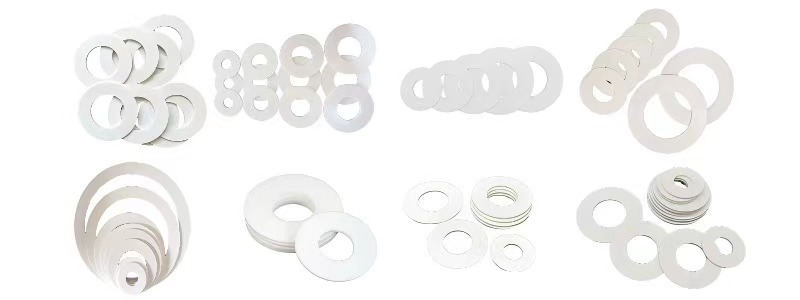
PTFE Gasket/ PTFE Filled Gasket
Ⅰ、Features
PTFE envelope gasket is a kind of static seals.It is composed of elastic materials such as compressed asbestos sheet,rubber,ceramics,etc. And PTFE envelope cover.
PTFE has superior properties against chemical(not affected by all chemicals except molten alkali metal and fluorine at elevated temperature) and temperature(from - 180℃ ~ +250℃)The coefficient of static and dynamic friction of PTFE are every low.PTFE is the best of the “non-stick”material. It has excellent anti weathering and aging characteristics.
Ⅱ、Types and Specifications:
PTFE Envelope Gasket

Note: (Thickness)Gasket slot width
PTFE Flange Gasket

Different standards of different specifications gasket, according to customer drawings for processing
Ⅲ、Applications
PTFE envelope gasket is used to seal pipe flange anti joint of industrial machinery apparatus which is lined with rubber,plastic ceramics graphite etc.
PTFE Envelope Gasket Technical Introduction
PTFE envelope gaskets are high-performance sealing elements composed of a polytetrafluoroethylene (PTFE) envelope layer composite with various reinforcing core materials. This product perfectly integrates the exceptional chemical inertness of PTFE with the mechanical strength of reinforcing materials, establishing a benchmark solution in modern industrial sealing.
Core Value Proposition
1. Chemical Protection Expert
Withstands highly corrosive media like 98% concentrated sulfuric acid and 37% hydrochloric acid, maintaining a stable seal under alternating acid-base conditions.
2. Extreme Condition Guardian
· Cryogenic Type: No embrittlement in -196°C liquid nitrogen environments.
· High-Temperature Type: Short-term temperature resistance up to 300°C (graphite reinforced version).
3. Intelligent Sealing Innovation
Latest models integrate pressure-sensing fibers for real-time seal status monitoring (optional).
Technology Evolution Milestones
· Fifth-generation products utilize gradient density compression technology, increasing edge sealing pressure by 50%.
· Nano-Al₂O₃ modified versions achieve a 60-year design life in nuclear power applications.
· Laser micro-perforation treatment technology increases sealing contact area by 70%.
Typical Application Scenarios
· Chemical Industry: Chlor-alkali production equipment, pickling line flange seals.
· Energy Sector: LNG terminal cryogenic pipelines, nuclear power plant main pumps.
· Electronics Manufacturing: Ultra-pure media transfer in semiconductor wet process equipment.
· Biopharmaceutical: Sterile bioreactors meeting FDA requirements.
Current Technology Frontiers:
· Graphene-modified gaskets under testing achieve thermal conductivity of 25 W/(m·K).
· 4D printed shape-memory gaskets can self-adapt to flange deformation.
· Biodegradable PTFE composite materials are in the pilot testing stage.
This product series covers full sizes from DN15 to DN3000, has passed 18 international certifications including ASME and PED, and has been successfully applied in major engineering projects across more than 50 countries worldwide.
Basic Characteristic Parameters
| Parameter Item | Technical Indicator | Test Standard |
| Material Composition | PTFE + Metal/Non-metal Core | ASTM D1710 |
| Operating Temperature | -196°C ~ +260°C (short-term 300°C) | ASTM D696 |
| Rated Pressure | 0.6 ~ 15 MPa (depending on structure type) | ASME B16.20 |
| Compression Rate | 15 ~ 25% | ASTM F36 |
| Recovery Rate | ≥ 15% | ASTM F36 |
| Density | 2.1 ~ 2.3 g/cm³ | ASTM D792 |
Structure Type Comparison
| Type | Core Material | Pressure Range | Characteristics | Applicable Standard |
| Standard Type | Rubber | ≤ 2.5 MPa | Economical, General Purpose | DIN 2690 |
| Reinforced Type | 304 Stainless Steel | ≤ 10 MPa | Compression & Creep Resistant | ASME B16.21 |
| High-elasticity Type | Graphite | ≤ 6 MPa | Good High-Temperature Stability | EN 1514-1 |
| Conductive Type | Carbon Fiber | ≤ 4 MPa | Surface Resistance 10⁴ Ω | ISO 8031 |
| Ultra-high Purity Type | PFA Composite | ≤ 3 MPa | Metal Ion Leachables < 0.1 ppb | SEMI F57 |
Typical Structure Types
| Type | Structural Features | Applicable Pressure | Typical Application |
| Rubber Core Envelope | PTFE envelope over NBR/SBR rubber | ≤ 2.5 MPa | Low-pressure acid/alkali pipelines |
| Metal Serrated Core | Stainless steel corrugated plate + double-sided PTFE envelope | ≤ 15 MPa | High-pressure flanges in petrochemicals |
| Graphite Reinforced | PTFE + Expanded Graphite composite layer | ≤ 10 MPa | High-temperature steam systems |
| Teflon® Composite | PFA inner layer + PTFE outer layer | ≤ 6 MPa | Ultra-high purity electronic chemical transfer |
Dimension Parameter Table
| Nominal Diameter DN | Flange OD (mm) | Gasket ID (mm) | Gasket Thickness (mm) |
| 15 | 95 | 18 | 1.5 / 3.0 |
| 50 | 165 | 55 | 2.0 / 3.0 |
| 100 | 220 | 105 | 2.5 / 4.5 |
| 300 | 400 | 305 | 3.0 / 5.0 |
| 600 | 705 | 610 | 4.0 / 6.0 |
Industry Certification Comparison
| Certification Standard | Certification Content | Applicable Industry |
| FDA 21 CFR 177.1550 | Food Contact Safety Certification | Food / Pharmaceutical |
| TA Luft | German Air Purity Standard | Chemical / Environmental |
| NORSOK M-710 | Norwegian Petroleum Standard | Oil & Gas Extraction |
| ASME B16.20 | US Standard for Pipe Flange Gaskets | General Industry |
| ISO 10993-5 | Biocompatibility for Medical Devices | Medical Equipment |
Selection Guide by Operating Condition
| Operating Requirement | Recommended | Type Technical Basis |
| Strong Acid + High Pressure (10 MPa) | Titanium Core Reinforced Type | Corrosion Resistance + High Strength |
| Cryogenic (-150°C) | Nano-SiO₂ Modified Type | Anti-Cold Flow |
| Frequent Disassembly | Graphite Filled Composite Type | Excellent Recovery Performance |
| Sterile Environment | Electropolished PFA Composite | Type Ra ≤ 0.5 μm |
| Explosive Atmosphere | Carbon Fiber Conductive Type | Surface Resistance ≤ 10⁶ Ω |
Innovative Technology Highlights
1. Surface Micro-structuring: Laser-engraved micron-level patterns increase sealing contact area by 70%.
2. Gradient Density Design: Multi-layer composite compression technology creates >20% higher density at the edges than the center.
3. Intelligent Early Warning: Embedded conductive fiber network for real-time seal failure monitoring (optional).
Industry Applications
· Chemical Industry: Reactors, pump/valve seals, resistant to special media like HF acid.
· Pharmaceutical Equipment: Sterile pipeline connections meeting FDA requirements.
· Energy Sector: LNG pipeline flanges, nuclear power plant cooling systems.
· Food Processing: Dairy fermentation tanks, juice filling line seals.
Selection Key Points
1. Media Compatibility: Verify PTFE resistance to specific chemicals.
2. Operating Parameters: Select core material type based on temperature/pressure (e.g., rubber core prohibited >150°C).
3. Flange Standard: Match flange face type (RF/FF/RJ, etc.) and dimensional accuracy.


