
Productscpzx


PTFE Gasket/ PTFE Filled Gasket
Ⅰ、Features
PTFE envelope gasket is a kind of static seals.It is composed of elastic materials such as compressed asbestos sheet,rubber,ceramics,etc. And PTFE envelope cover.
PTFE has superior properties against chemical(not affected by all chemicals except molten alkali metal and fluorine at elevated temperature) and temperature(from - 180℃ ~ +250℃)The coefficient of static and dynamic friction of PTFE are every low.PTFE is the best of the “non-stick”material. It has excellent anti weathering and aging characteristics.
Ⅱ、Types and Specifications:
PTFE Envelope Gasket

Note: (Thickness)Gasket slot width
PTFE Flange Gasket

Different standards of different specifications gasket, according to customer drawings for processing
Ⅲ、Applications
PTFE envelope gasket is used to seal pipe flange anti joint of industrial machinery apparatus which is lined with rubber,plastic ceramics graphite etc.
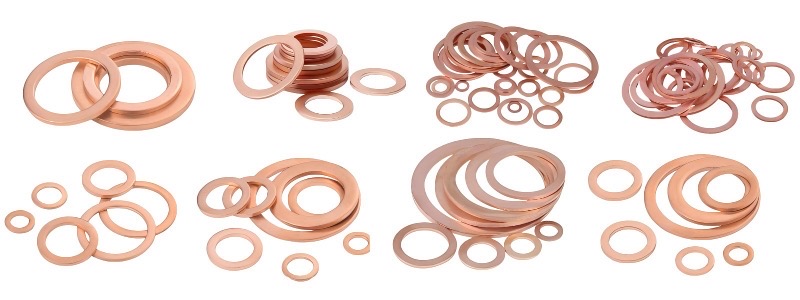
Professional Specification for Red Copper Gaskets
Red copper gaskets are metallic sealing elements manufactured from high-purity red copper (Cu ≥ 99.9%). Leveraging their excellent thermal conductivity, electrical conductivity, and plastic deformation capability, they are the preferred sealing solution for high-temperature and high-pressure conditions. This product uses high-quality T2 red copper as raw material, processed with precision machining and special treatment techniques to ensure reliable sealing performance under various harsh operating conditions.
Core Advantages
1. Exceptional Physical Properties
· Thermal conductivity up to 398 W/(m·K), 24 times higher than ordinary stainless steel gaskets.
· Electrical conductivity reaches 100% IACS standard, ensuring excellent electrical connection performance.
· Strong plastic deformation ability, with a compressibility of 30-50%.
2. Outstanding Condition Adaptability
· Ultra-wide temperature range: -196℃ ~ +600℃ (Serrated Gaskets)
· Ultra-high pressure resistance: Up to 45 MPa (Serrated structure)
· Excellent resistance to hydrogen embrittlement and radiation.
3. Economic & Practical Characteristics
· Reusable 3-5 times (intermediate annealing treatment required).
· Easy installation, recommended bolt torque only 20-30 N·m.
· Multiple surface treatment options available to meet different needs.
Product Series
1. Standard Flat Gaskets
· Thickness: 0.5-3.0 mm
· Working Pressure: ≤ 25 MPa
· Suitable for general medium-low pressure conditions.
2. Serrated Gaskets
· Tooth Height: 0.1-0.3 mm
· Working Pressure: ≤ 45 MPa
· Specifically designed for high-pressure and high-temperature conditions.
3. Clad Gaskets
· PTFE or Graphite cladding surface.
· Significantly improved corrosion resistance.
· Suitable for corrosive media environments.
Typical Applications
· Energy & Power: Steam turbines, boiler system sealing.
· Petrochemical: Hydrogenation reactors, high-pressure heat exchangers.
· Refrigeration Engineering: Low-temperature pipeline connections.
· Vacuum Equipment: High vacuum chamber sealing.
· Electronics & Electrical: High-conductivity connection components.
Quality Assurance
· Raw material complies with GB/T 5231 standard.
· Dimensional accuracy meets ISO 9443 requirements.
· Multiple surface treatment options provided:
· Mirror Polishing (Ra ≤ 0.4 μm)
· Silver Plating (Contact resistance < 0.5 mΩ)
· Oxidation Treatment (Hardness increased by 30%)
Usage Recommendations
1. Clean sealing surfaces before installation to ensure they are free of contaminants.
2. Tighten bolts evenly according to the recommended torque values.
3. Annealing treatment is recommended before use in high-temperature conditions.
4. Do not exceed 5 reuses.
Note: This product is available in standard sizes from DN15 to DN600, and custom sizes are also supported. The latest R&D includes nano-crystalline red copper gaskets (grain size ≤ 1 µm)...
Basic Performance Parameters
Parameter Item
Standard Flat Gasket
Serrated Gasket
Clad Gasket
Test Standard
Material
T2 Red Copper (Cu≥99.9%)
T2 Red Copper + Serrated Surface
T2 Red Copper + PTFE/Graphite Cladding
GB/T 5231
Working Temp. (°C)
-196 ~ +450
-196 ~ +600
-200 ~ +300
ASTM B187
Working Pressure (MPa)
≤ 25
≤ 45
≤ 15
ASME B16.20
Hardness (HB)
35-75
60-95
40-80
ASTM E10
Thickness (mm)
0.5-3.0
1.0-5.0
1.5-4.0
ISO 9443
Surface Roughness Ra(μm)
≤ 1.6
≤ 3.2
≤ 0.8
ISO 4287
Physical Performance Comparison
Performance Indicator
Red Copper Gasket
304 Stainless Steel Gasket
Advantage Comparison
Thermal Conductivity (W/(m·K))
398
16
24x Higher ↑
Electrical Conductivity (%IACS)
100
2.5
40x Higher ↑
Thermal Expansion Coeff. (10⁻⁶/°C)
17
17.3
Comparable
Radiation Resistance
Excellent
Good
Better
Hydrogen Embrittlement Resistance
Excellent
Poor
Significant Advantage
Dimensional Specification Table
Nominal Diameter DN
Inner Dia. (mm)
Outer Dia. (mm)
Standard Thickness (mm)
Serrated Gasket Thickness (mm)
15
16
38
1.0
1.5
50
53
102
1.5
2.5
100
108
1658*
2.0
4.0
600
620
685
3.0
5.0
300
325
370
2.5
4.0
Note: Please verify the Outer Diameter for DN100 (1658 mm seems unusually large compared to adjacent sizes).
Application Condition Reference Table
Condition
Recommended Type
Technical Basis
High-Pressure Steam (≤45MPa)
Serrated Gasket
Serrated structure enhances sealing
Ultra-Low Temperature (-196°C)
Annealed Flat Gasket
Maintains low-temperature toughness
Corrosive Media
PTFE Clad Gasket
Corrosion resistance protection
High Vacuum Environment
Mirror Polished Flat Gasket
Ra ≤ 0.4 μm surface
Electrical Conductivity Requirement
Standard Flat Gasket
100% IACS
Mechanical Performance Parameters
Performance Indicator
Annealed Condition
Hard Condition
Test Standard
Tensile Strength (MPa)
200-250
300-350
ASTM E8
Elongation (%)
≥ 40
≥ 25
ASTM E8
Yield Strength (MPa)
60-80
250-300
ASTM E8
Fatigue Life (Cycles)
50,000
30,000
ASTM E606
Product Types (Summary)
1. Standard Flat Gaskets
· Thickness: 0.5-3 mm
· Applicable Pressure: ≤ 25 MPa
2. Serrated Gaskets
· Sealing Tooth Height: 0.1-0.3 mm
· Applicable Pressure: ≤ 45 MPa
3. Clad Gaskets
· PTFE/Graphite Cladding
· Improved corrosion resistance
Application Fields (Summary)
· Petrochemical: Hydrogenation reactors, high-pressure heat exchangers.
· Power Equipment: Steam turbines, boiler systems.
· Refrigeration Engineering: Low-temperature pipeline connections.
· Vacuum Equipment: High vacuum chamber sealing.
Selection Guide (Summary)
1. Standard Flat Gaskets for conventional conditions.
2. Serrated Gaskets for high-pressure conditions.
3. Clad Gaskets for corrosive environments.
4. Annealing treatment is required for ultra-high vacuum environments.


