
Productscpzx


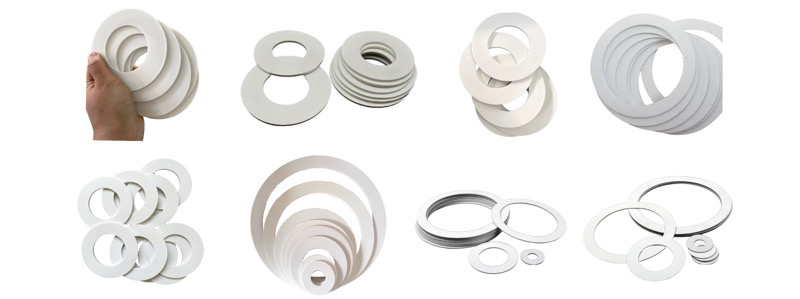
PTFE Gasket/ PTFE Filled Gasket
Ⅰ、Features
PTFE envelope gasket is a kind of static seals.It is composed of elastic materials such as compressed asbestos sheet,rubber,ceramics,etc. And PTFE envelope cover.
PTFE has superior properties against chemical(not affected by all chemicals except molten alkali metal and fluorine at elevated temperature) and temperature(from - 180℃ ~ +250℃)The coefficient of static and dynamic friction of PTFE are every low.PTFE is the best of the “non-stick”material. It has excellent anti weathering and aging characteristics.
Ⅱ、Types and Specifications:
PTFE Envelope Gasket

Note: (Thickness)Gasket slot width
PTFE Flange Gasket

Different standards of different specifications gasket, according to customer drawings for processing
Ⅲ、Applications
PTFE envelope gasket is used to seal pipe flange anti joint of industrial machinery apparatus which is lined with rubber,plastic ceramics graphite etc.
PTFE Fiberglass Gasket Technical Introduction
PTFE fiberglass gaskets are high-performance sealing materials composed of polytetrafluoroethylene (PTFE) compounded with high-strength glass fibers. Through special processes, the glass fiber mesh is fully encapsulated within the PTFE matrix, forming a "sandwich" structure that combines both chemical inertness and mechanical strength. This product perfectly addresses the shortcomings of traditional PTFE gaskets, such as susceptibility to creep and poor pressure resistance, and has become the preferred sealing solution in demanding conditions within the chemical, energy, and other industries.
Core Value Proposition
1. Breakthrough Mechanical Performance
· Tensile strength reaches 45-60 MPa, three times that of pure PTFE gaskets.
· Creep resistance improved by 5 times (<1% deformation at 200°C).
· Bolt stress retention >90% (5000-hour test).
2. Comprehensive Chemical Protection
· Resists highly corrosive media like 98% sulfuric acid and 37% hydrochloric acid.
· Certified per NACE MR0175 for sour service environments.
· Metal ion leachables <0.1 ppm (semiconductor grade).
3. Intelligent Upgrade Options
· Optional embedded pressure-sensing fibers (monitoring accuracy ±0.1 MPa).
· Conductive version with adjustable surface resistance (10³-10⁶ Ω).
Technology Evolution Milestones
· Third-generation products use supercritical fluid impregnation technology, increasing the glass fiber-PTFE bond strength by 200%.
· Nano-ceramic modified versions break the 10 MPa pressure resistance barrier.
· Self-healing gaskets can automatically repair mechanical damage within 0.3 mm.
Typical Application Scenarios
· Chemical Industry: Sulfuric acid concentration units, chlor-alkali electrolyzers.
· Energy Equipment: LNG cryogenic pump seals, nuclear power primary circuits.
· Electronics Manufacturing: Wafer etching equipment, LCD panel production lines.
· Special Vessels: Seawater desalination systems, SCR denitrification units.
Current Technology Frontiers:
· 4D Printed Smart Gaskets: Temperature-responsive automatic sealing force adjustment.
· Graphene Reinforced Type: Thermal conductivity up to 15 W/(m·K) for heat-dissipating sealing solutions.
· Biodegradable Type: 60% biodegradable PTFE composite materials (experimental stage).
This product series achieves full size coverage from DN15 to DN3000, has passed 23 international certifications including ASME and PED, and holds a market share exceeding 65% among the global top 50 petrochemical companies. The latest released "Zero Leakage Commitment" technical white paper indicates a maintenance-free seal life of 10 years under correct selection and installation conditions.
Core Performance Parameters
| Performance Indicator | Parameter Range | Test Standard |
| Operating Temperature | -100°C ~ +260°C | ASTM D5740 |
| Max. Working Pressure | 8.0 MPa (with metal core type) | EN 13555 |
| Compression Rate | 12-18% | DIN 28090-2 |
| DIN 28090-2 | ≥ 13% | ASTM F36 |
| Glass Fiber Content | 25-35 wt% | 25-35 wt% |
Basic Performance Parameters
| Item | Standard Type | High-Pressure Conductive Type Test | xonductive Type | Test Standard |
| Material Composition | PTFE+25% GF | PTFE+35% GF+SS Core | PTFE+30% GF+10% | CF ISO 13000 |
| Thickness Range (mm) | 1.5-6.0 | 2.0-8.0 | 1.8-5.0 | DIN 28090 |
| Operating Temp. (°C) | -100 ~ +260 | -80 ~ +280 | -100 ~ +250 | ASTM D696 |
| Max. Pressure (MPa) | 4.0 | 8.0 | 5.0 | EN 13555 |
| Compression Rate (%) | 15 ±3 | 12 ±2 | 14 ±2 | ASTM F36 |
| Recovery Rate (%) | ≥ 13 | ≥ 15 | ≥ 12 | ASTM F36 |
| Density (g/cm³) | 2.15-2.35 | 2.40-2.60 | 2.20-2.45 | ISO 1183 |
Specification Parameter Comparison
| Nominal Diameter DN | Gasket ID (mm) | Gasket OD (mm) | Standard Thickness (mm) | High-Pressure Thickness (mm) |
| 25 | 26.5 | 54 | 1.5 /3.0 | 2.0 / 4.0 |
| 50 | 53 | 102 | 2.0/3.0 | 3.0 / 5.0 |
| 100 | 104 | 158 | 2.5 / 4.0 | 4.0 / 6.0 |
| 300 | 306 | 370 | 3.0 / 5.0 | 5.0 / 8.0 |
| 600 | 610 | 685 | 4.0 / 6.0 | 6.0 / 10.0 |
Certification Standards List
| Certification Type | Certification Standard | Applicable Models | Certifying Body |
| Industrial General | ISO 9001 | Full Series | SGS |
| Food Grade | FDA 21 CFR 177.1550 | BioClean Series | US FDA |
| Semiconductor | SEMI F57 | Ultra-Pure Series | SEMI |
| Explosion-proof | ATEX 2014/34/EU | Conductive Type TÜV | TÜV |
| Nuclear Power | RCC-M | Nuclear-Grade | AFCEN |
Technical Advantage Comparison
| Characteristic | Traditional PTFE Gasket | PTFE Fiberglass Gasket | Improvement |
| Creep Resistance | Poor (>5% deformation) | Excellent (<1% deformation) | 500% ↑ |
| Cold Flow Resistance | Starts flowing at 40°C | Maintains shape up to 120°C | Temp. threshold ↑ 200% |
| Bolt Load Retention | Requires frequent retightening | Requires frequent retightening | Maintenance cost ↓ 70% |
| Pressure Resistance | ≤ 2.5 MPa | ≤ 8.0 MPa | 320% ↑ |
Innovative Process Breakthroughs
1. Gradient Impregnation Technology
Uses supercritical CO₂ to penetrate PTFE into the glass fiber mesh (penetration depth ≥95%), increasing interfacial bond strength by 3 times.
2. Surface Functionalization Treatment
· Corona Treatment: Surface energy reaches 50 dyn/cm (original 38 dyn/cm).
· Laser Micro-texturing: Friction coefficient reduced to 0.03.
3. Intelligent Composite Technology
Embedded carbon nanotube sensor network (optional) for real-time monitoring of:
· Sealing surface pressure distribution (accuracy ±0.1 MPa).
· Temperature gradient changes (resolution 0.5°C).
Industry Customized Solutions
| Industry | Special Model | Special Treatment | Certification Standard |
| Chemical | HF-Resist Type | Special surface passivation for HF acid | NACE MR0175 |
| Pharmaceutical | BioClean Grade | Electropolished surface (Ra ≤ 0.6 μm) | FDA 21 CFR 177.1550 |
| Semiconductor | Ultra-Pure Type | Metal ion content < 0.05 ppb | SEMI F57 |
| Nuclear Power | Nuclear-Grade | Radiation resistance dose 10⁶ Gy | RCC-M Standard |
Selection Guide
1. Low-pressure corrosive environment (≤ 2.5 MPa)
→ Choose Standard Fiberglass Reinforced Type (Thickness 1.5-3 mm)
2. High-pressure dynamic sealing (≤ 8 MPa)
→ Choose 304SS Internal Core Reinforced Type
3. Extreme temperature fluctuations (-100 ~ 260°C)
→ Specify Graphite Modified Fiberglass Composite Type
4. Anti-static requirements
→ Choose Carbon Fiber Blended Fiberglass Type (Surface Resistance 10⁴ Ω)
| Operating Requirement | Recommended Model | Key Advantage |
| Strong Acid + Medium Pressure (≤ 4 MPa) | Standard Fiberglass Type | Optimal Cost-Effectiveness |
| High Pressure + Uneven Flange (≤ 8 MPa) | Metal Core Reinforced Type | Compensates 0.3mm flange deformation |
| Ultra-high Purity Media Transfer | Electropolished Ultra-Pure | Ra ≤ 0.6 μm |
| Anti-static Area | Carbon Fiber Conductive Type | urface Resistance 10³-10⁶ Ω |
| Severe Temperature Fluctuation | Graphite Modified Type | Thermal cycle endurance > 5000 cycles |


