
Productscpzx


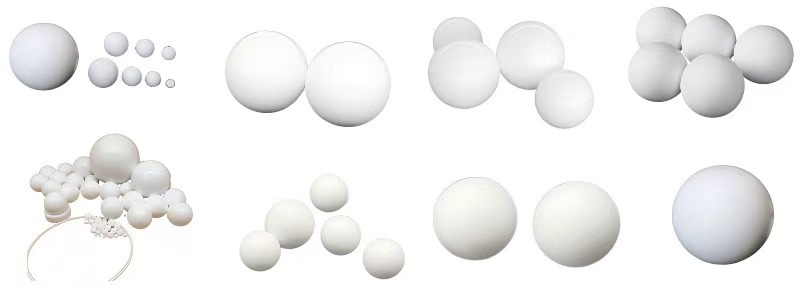
PTFE Ball Product Introduction
· Medical Devices: Implant device components (ISO 10993 certified).
Product Series
Model
Characteristics
Applicable Scenarios
Standard Type
Pure PTFE, economical & practical
General corrosive environments
Reinforced Type
Glass fiber reinforced, strength +50%
High-pressure & high-temperature situations
Conductive Type
Carbon fiber modified, anti-static
Flammable & explosive areas
Medical Grade
Ultra-high purity, biocompatible
Implantable medical devices
Quality Assurance
· Raw Material Control: Uses imported PTFE raw materials from DuPont, Daikin, etc.
· Process Standard: ISO 9001 Quality Management System certified.
· Inspection Items:
· 100% Roundness inspection (accuracy 0.001mm)
· Spark test for porosity (20kV)
· Chemical purity analysis (ICP-MS)
Service Support
· Professional engineer selection consultation.
· Custom processing based on provided drawings or samples.
· Material certificates and test reports provided.
Basic Performance Parameters
Performance Indicator
Standard Value
Reinforced Type (25% GF)
Test Standard
Density (g/cm³)
2.1-2.3
2.3-2.5
ISO 1183
Compressive Strength (MPa)
25-35
45-60
ISO 604
Coefficient of Friction
0.04-0.1
0.08-0.15
ASTM D1894
Heat Deflection Temp.(°C / 0.45MPa)
120
150
ISO 75-1
Surface Resistivity (Ω)
>10¹⁵
10³-10⁶
(Conductive Type) IEC 60093
Product Specification Parameters
Parameter
Standard Range
High-Precision Custom Range
Tolerance Grade
Diameter (mm)
1-300
0.5-500
±0.1mm (Standard)
±0.01mm (Precision)
Roundness Error (mm)
≤0.05
≤0.005
ISO 1101
Surface Roughness (μm)
Ra 0.8-3.2
Ra 0.1-0.4
ISO 4287
Through-Hole Diameter (mm)
0.3-50
0.1-100
±0.05mm
Product Type Comparison
Model
Material Composition
Key Characteristics
Typical Application
PTFE-P
Pure PTFE
Ultra-high Purity
Semiconductor / Medical
PTFE-GF25
25% Glass Fiber
High Rigidity
High-Pressure Valves
PTFE-CF15
15% Carbon Fiber
Conductivity
Anti-static Situations
PTFE-M20
20% MoS₂ Filled
Ultra-low Friction
Non-lubricated Bearings
Industry Certification Standards
| Certification Type | Standard Number | Applicable Field |
| Food Grade | FDA 21 CFR 177 | Food & Pharmaceutical |
| Medical Device | ISO 10993-1 | Human Implantation |
| Semiconductor | SEMI F57 | Wafer Manufacturing |
| Industrial General | ASTM D4894 | General Components |
Selection Guide
Application Scenario
Recommended Model
Key Parameter Requirements
Ball Valve Core
PTFE-GF25
Roundness ≤0.01mm
Metering Pump Component
PTFE-P
Ra ≤0.2μm
Conductive Situations
PTFE-CF15
Resistance <10⁶Ω
Food Processing
FDA Certified Pure PTFE
No Additives
Innovative Technology Breakthroughs
1. Material Modification Technology
(1) Nano-Composite Reinforcement
· Technology Principle: Adding nano-alumina/silicon carbide particles (<50nm diameter) into the PTFE matrix.
· Performance Improvement:
· Wear resistance improved by 8-10 times (wear rate reduced to 0.3×10⁻⁶mm³/N·m).
· Compressive strength breakthrough 60MPa (2.5 times that of pure PTFE).
· Application Scenarios: High-pressure ball valves, aerospace hydraulic systems.
(2) Functionally Graded Material
· Technology Implementation: Gradient structure manufactured by layered sintering process.
· Core Layer: Pure PTFE ensures chemical inertness.
· Transition Layer: 25% Glass Fiber reinforced.
· Surface Layer: 5% MoS₂ modified.
· Advantage: Simultaneously meets corrosion resistance + high strength + self-lubrication requirements.
2. Structural Innovation Design
(1) Bionic Surface Structure
· Technical Features:
· Mimics the micro-nano structure of lotus leaf surface.
· Laser-engraved 20-50μm level pit array.
· Effects:
· Friction coefficient reduced to 0.02 (dry friction conditions).
· Anti-fouling capability improved by 300%.
(2) Smart Hollow Ball
· Technical Highlights:
· Built-in miniature pressure/temperature sensors.
· Uses RFID for wireless data transmission.
· Application:
· Real-time monitoring of valve working status.
· Predictive maintenance (life prediction accuracy ±5%).
3. Advanced Manufacturing Processes
(1) 3D Printing Forming
· Process Parameters:
· Material: PTFE composite powder (particle size 15-45μm).
· Printing Temperature: 380±5°C.
· Layer Thickness: 0.05-0.1mm.
· Advantages:
· Can manufacture complex internal flow channel structures (minimum channel Φ0.3mm).
· Reduces material waste (utilization rate >95%).
(2) Ultra-Precision Machining
· Technical Breakthrough:
· Uses diamond lathe machining.
· Spindle speed 50,000 rpm.
· Results:
· Spherical roundness reaches 0.001mm.
· Surface roughness Ra 0.01μm (mirror grade).
4. Surface Treatment Technology
(1) Plasma Activation
· Treatment Effect:
· Surface energy increases from 18 mN/m to 72 mN/m.
· Bonding strength increases by 15 times.
· Application: Medical devices requiring bonded components.
(2) Ion Implantation Modification
· Technical Parameters:
· Implanted Elements: N⁺/C⁺.
· Energy: 50-100 keV.
· Performance Changes:
· Surface hardness increases by 300%.
· Wear resistance improves by 20 times.
5. Intelligent Development
(1) Self-Sensing Ball
· Integration Technology:
· Embedded fiber optic sensing.
· Strain measurement accuracy ±0.1%.
· Function: Real-time monitoring of sealing surface wear status.
(2) Adaptive Deformation
· Technical Principle:
· Shape memory PTFE composite material.
· Temperature-induced deformation rate up to 15%.
· Application: Self-adaptive ball valves for intelligent flow regulation.
6. Environmental Innovation
(1) Recycled PTFE Application
· Process Breakthrough:
· Recycled material purity >99.9%.
· Performance retention rate >90%.
· Benefit: Production cost reduced by 35%.
(2) Bio-based PTFE
· Technical Feature:
· 30% raw materials from plant extracts.
· Carbon footprint reduced by 40%.
Industry Application Cases
· Semiconductor:
· Ultra-high purity nano-PTFE balls (metal content <0.1 ppb).
· Used in wafer cleaning equipment.
· Energy:
· Carbon fiber reinforced conductive balls.
· Key components in hydrogen energy valves.
· Medical:
· Porous structure PTFE balls (porosity 70%).
· Drug sustained-release carriers.
Technology Development Trends
1. 4D Printing Technology: Temperature/electric field-responsive smart balls.
2. Superconducting PTFE: For cryogenic systems in quantum devices.
3. Self-Healing Materials: Micro-encapsulated healing agents automatically repair cracks.


