
Productscpzx


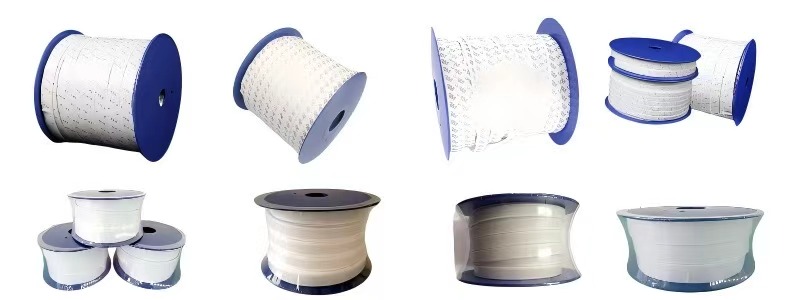
Expanded PTFE Sheet/tape
Ⅰ、Features
Polytetrafluoroethylene is a new type of polymer materials. Polytetrafluoroethylene resin by special processing methods. White, flexible and flexible, with a network of fine fibers connected to form a network of these fine fibers to form numerous pores, the expanded PTFE can be arbitrary bending (over 360 degrees), the expansion of polytetrafluoroethylene Has a good anti-chemical, anti-wear properties and extremely high temperature, low temperature capability, ideal for industrial liquid seal.
Ⅱ、Types and Specifications:

Ⅲ、Main Properties:

Ⅳ、Applications
PTFE gasket for pipe, flange and rubber, plastic, enamel, graphite pieces of industrial machinery in the joints at the sealing material.
PTFE Expansion Tape Product Introduction
PTFE expansion tape is a scalable sealing material made from pure polytetrafluoroethylene (PTFE) through special processing. Its unique thermal expansion property makes it an ideal sealing solution for high-temperature and high-pressure applications.
Core Characteristics
| Property | Technical Parameters | Core Advantages |
| Intelligent Expansion | Begins expansion at 150°C, up to 200% expansion rate | Automatic gap compensation |
| Temperature Resistance | -200°C ~ +260°C long-term stable operation | Reliable performance in extreme temperatures |
| Multiple Sealing Mechanisms | Combines mechanical compression and thermal expansion sealing | Dual protection for enhanced safety |
| Safety & Environmental Compliance | Asbestos-free, FDA certified (21 CFR 177.1550) | Safe for food and pharmaceutical applications |
Product Advantages
· Emergency Sealing: Automatically compensates for seal gaps when temperature rises
· Easy Installation: Direct winding application, no pre-forming required
· Long-Term Stability: Service life of 3-5 years at 260°C
· Versatility: Suitable for irregular sealing surfaces
Typical Applications
Industrial Sealing
✅ Emergency sealing for high-temperature flanges (sudden leaks)
✅ Supplementary sealing for valve stuffing boxes
Energy Equipment
✅ Compensation sealing for steam pipelines
✅ Maintenance sealing for heat exchangers
Specialized Fields
✅ Nuclear power plant pipeline sealing (RCC-M certified)
✅ Spacecraft fuel pipeline sealing
Usage Guide
1. Installation Steps
· Clean sealing surface (Ra ≤ 3.2μm)
· Spiral winding (50% overlap rate)
· Initial compression force: 10-15 N/mm²
2. Activation Conditions
· Minimum activation temperature: 150°C
· Optimal activation range: 180-220°C
· Full expansion time: 30-60 minutes
3. Maintenance Recommendations
· Annual inspection of expansion status
· Re-tightening during system shutdown
· Maximum 3 reuses
Quality Certifications
· API 6A (Petroleum Equipment Certification)
· ISO 9001 Quality Management System
· PED 2014/68/EU (Pressure Equipment Directive)
· ASME B16.20 (Pipe Flange Sealing)
Selection Guide
| Application | Recommended Type | Special Features |
| Conventional Sealing | 1.0mm Standard Type | General purpose |
| High Pressure Conditions | 1.5mm Thick Type | Enhanced pressure resistance |
| Quick Emergency Response | Low-Temperature Activation Type (starts at 120°C) | Faster response |
| Nuclear Applications | Special Type with Barrier Layer | RCC-M nuclear grade |
Detailed Technical Parameters
| Parameter | Value Range/Description | Test Standard |
| Chemical Composition | Pure PTFE or modified additives (graphite, glass fiber) | ASTM D4894 |
| Density | 2.14-2.20 g/cm³ | ISO 1183 |
| Tensile Strength Longitudinal | ≥15 MPa, Transverse ≥10 MPa | ASTM D638 |
| Elongation at Break | 200-400% | ASTM D638 |
| Dielectric Constant | 1.8-2.2 (1MHz) | ASTM D150 |
| Volume Resistivity | ≥10¹⁸ Ω·cm | ASTM D257 |
| Friction Coefficient | 0.05-0.10 (dynamic, steel vs PTFE) | ASTM D1894 |
| Thermal Expansion Coefficient | 10-15×10⁻⁵/℃ (20-100℃) | ASTM E831 |
| Flammability | Non-flammable (oxygen index ≥95%) | ASTM D2863 |
Detailed Specifications Comparison
| Parameter | Ultra-Thin (Precision) | Standard | Thick (High Pressure) | Wide Width (Large Diameter) |
| Thickness (mm) | 0.04-0.07 | 0.08-0.12 | 0.15-0.30 | 0.10-0.15 |
| Width (mm) | 12 | 19, 25 | 25, 50 | 50, 75, 100 |
| Pressure Rating (MPa) | ≤5 | ≤16 | ≤40 | ≤16 |
| Temperature Range (°C) | -100~+200 | -200~+260 | -200~+300 | -200~+260 |
| Typical Applications | Instrument pipes, electronic components | Water pipes, gas pipes | High pressure systems | Large chemical flanges |
Chemical Compatibility Guide
| Medium Type | Tape Selection Requirements | Prohibited Scenarios |
| Oxygen/High Purity Gases | Grease-free grade (pink), residual grease ≤0.1mg/m² | Standard white tape |
| Strong Acids (e.g., concentrated sulfuric acid) | Pure PTFE without additives, thickness ≥0.15mm | Graphite modified types |
| Food/Pharmaceutical | FDA certified, heavy metal content ≤0.005% | Industrial general purpose |
| Cryogenic (LNG) | -200°C low temperature toughened treatment, no cracking risk | Recycled material tapes |
Industry Application Classification
| Industry | Specific Application Scenarios | Special Requirements |
| Petrochemical | Reactor flange sealing, corrosive media pipelines (sulfuric acid, hydrochloric acid) | High pressure resistance (≥10MPa), stress corrosion resistance |
| Food & Pharmaceutical | Sterile pipelines, fermentation tank threaded connections | FDA certified, no leachables |
| Energy & Power | team turbine pipelines, nuclear plant cooling systems | Radiation resistance, high temperature resistance (300°C short-term) |
| Semiconductor | High purity gas delivery (silane, helium) | Dust-free, oil-free, ESD protection |
| Aerospace | Hydraulic systems, fuel pipelines | MIL-STD-27730A standard |
| Civil Construction | HVAC, gas inlet pipes | Flame retardancy (UL94 V-0) |
Detailed Physical Properties
| Property | Test Conditions | Typical Value | Unit | Test Standard |
| Density | 23°C | 2.15-2.20 | g/cm³ | ISO 1183 |
| Tensile Strength | 23°C,50mm/min | 15-30 | MPa | ASTM D638 |
| Elongation at Break | 23°C | 200-400 | % | ASTM D638 |
| Compression Set | 0MPa, 24h, 23°C | ≤15 | % | ASTM D395 |
| Thermal Conductivity | 100°C | 0.24-0.28 | W/(m·K) | ASTM E1461 |
| Linear Expansion Coefficient | 20-100°C | 12×10⁻⁵ | /°C | ASTM E831 |
| Friction Coefficient | Steel vs PTFE, 0.5m/s | 0.05-0.08 | - | ASTM D1894 |
Chemical Resistance Table
| Chemical Medium | Concentration | Resistance (23°C) | Max Temperature | Failure Mode |
| Sulfuric Acid | 98% | Excellent | 200°C | Decomposes >260°C producing HF |
| Sodium Hydroxide | 50% | Good (≤100°C) | 80°C | Penetration and swelling at high temperature |
| Acetone | 100% | Excellent (grease-free type) | -200°C | Grease causes explosion |
| Wet Chlorine | 100% | Poor | Prohibited | Stress corrosion cracking |
| Gasoline | Commercial 92# | Excellent | 120°C | Weight gain <0.1% after long-term immersion |
| Liquid Oxygen | -183°C | Excellent (grease-free type) | -200°C | Grease causes explosion |
Testing Standards Comparison
| Test Item | Chinese Standard | International Standard | Test Method Highlights |
| Thickness Uniformity | GB/T 6672 | ISO 4591 | 10-point micrometer measurement, deviation ≤±0.01mm |
| Tensile Performance | GB/T 1040.3 | ASTM D638 | Dumbbell specimen, 50mm/min tensile speed |
| Sealing Test | HG/T 3987 | EN 751-1 | 1.5× working pressure, hold 30 minutes no leakage |
| Volatile Content | GB/T 2914 | ASTM D1901 | 105°C oven 2h, weight loss ≤0.5% |
| Food Safety | GB 4806.1 | FDA 21 | CFR 177 Heavy metals (Pb/Cd/Hg) ≤0.005mg/kg |
| Flame Retardancy | GB/T 2408 | UL94 | Vertical burn test, self-extinguishing time <10s |
Special Condition Adaptation Guide
| Extreme Condition | Adaptation Solution | Verification Standard |
| Ultra High Pressure (>40MPa) | Glass fiber reinforced PTFE tape (0.3mm thick) + MoS₂ coating | API 6A Appendix F |
| High Radiation Environment | Gray tape with radiation resistant additives (lead powder), cumulative dose tolerance ≥10⁶ Gy | ASTM D1879 |
| Ultra Clean Requirements | Silicon-free, dust-free type, particle release <0.1μm (100 particles/ft³) | ISO 14644-1 Class 1 |
| Dynamic Vibration Scenarios | Composite use with pre-applied thread lock adhesive (e.g., Loctite 577) | DIN 267-27 |


