
Productscpzx

Typical Application Fields
Application Field
Specific Scenarios
Key Requirements
Chemical / Petrochemical
Reactor, distillation column, heat exchanger flanges
Corrosion resistance, high temperature, creep resistance
Semiconductor / Photovoltaic
High-purity gas/chemical delivery pipelines
Ultra-high purity, low outgassing, non-contaminating
Food & Pharmaceutical
Fermentation tanks, filling lines, CIP systems
FDA certified, non-toxic, easy to clean
Energy & Power
Nuclear/high-temperature steam lines in power plants
High temperature/pressure resistance, radiation resistance
Aerospace
Fuel systems, hydraulic systems, engines
Wide temperature range, media resistance, long life
Automotive Manufacturing
Fuel cells, new energy battery packs
Coolant resistance, reliable sealing
Technological Frontiers
1. Multifunctional Composite Technology
Conductive ePTFE Gaskets: Added carbon nanotubes, surface resistivity 10²-10⁶ Ω, for static dissipation.
Thermally Conductive ePTFE Gaskets: Filled with boron nitride/alumina, thermal conductivity >1.5 W/m·K.
Flame-Retardant ePTFE Gaskets: Special formulations achieving UL94 V-0 rating.
2. Structural Innovation & Design
Graded-Density Structure: Dense surface layer for permeation resistance, soft inner layer for high resilience.
Corrugated/Serrated Structure: Increases localized contact pressure, optimizing sealing performance.
Pre-compressed Forming: Pre-compressed ex-factory, achieving optimal seal immediately upon installation.
3. Smart Sealing Technology
Sensor-Integrated Gaskets: Embedded fiber optic sensors for real-time monitoring of seal status and temperature.
Self-Healing Gaskets: Microcapsule technology that releases sealant upon micro-leakage.
Gasket Types & Structures
Gasket Type
Structural Features
Applicable Conditions
Sealing Mechanism
Standard Flat Gasket
Cut from uniform ePTFE sheet
General static seals, pressure <10 MPa
Compression-Recovery Seal
Inner Ring Gasket
ePTFE + 304/316L inner ring
High pressure, blow-out prevention, gasket protection
Inner Ring Positioning + Compression Seal
Clad Gasket
ePTFE envelope over graphite/ceramic fiber core
High temperature/pressure, anti-extrusion
Core Pressure Bearing + ePTFE Seal
Serrated/Corrugated Gasket
Embossed or serrated surface
Uneven flange surfaces
Line Contact, High Specific Pressure
Spiral Wound Gasket
Wound ePTFE filler strip + metal strip
High temperature/pressure, thermal cycling
Metal Skeleton Pressure Bearing + ePTFE Seal
O-Ring Cross-Section
ePTFE cord formed into O-ring shape
Groove seals, replacing rubber O-rings
Compression-Recovery, No Cold Flow
Custom-Shaped Gaskets
CNC cut / molded
Complex flange faces, non-standard equipment
Precise Fit to Sealing Surface
Key Performance Parameters Table
Performance Indicator
Standard ePTFE Gasket
Reinforced ePTFE Gasket
Test Standard
Density (g/cm³)
0.4 – 0.8
0.6 – 1.2
ASTM D792
Tensile Strength (MPa)
MD: 10-25 / TD: 5-15
MD: 15-40 / TD: 10-25
ASTM D638
Elongation at Break (%)
50 – 200
30 – 100
ASTM D638
Compressibility (%)
15 – 30
10 – 25
ASTM F36
Recovery (%)
40 – 60
30 – 50
ASTM F36
Creep Relaxation (%)
<5 (24h, RT)
<3 (24h, RT)
ASTM F38
Leak Rate (mbar·L/s)
<10⁻⁴ (Nitrogen)
<10⁻⁵ (Nitrogen)
EN 13555
Thermal Conductivity (W/m·K)
0.05 – 0.10
0.10 – 0.25
ASTM E1530
Chemical Resistance Table
Chemical Medium
Concentration
Max. Temp. (°C)
ePTFE Compatibility
Recommended Gasket Type
Hydrofluoric Acid
≤50%
100
Excellent
Standard or Reinforced
Concentrated Sulfuric Acid
98%
200
Excellent
Standard
Nitric Acid
68%
150
Excellent
Standard
Sodium Hydroxide
50%
100
Excellent
Standard
Aqua Regia
Concentrated
100
Excellent (short-term)
Reinforced
Acetone
Acetone
60
Excellent
Standard
Benzene
100%
100
Excellent
Standard
Liquid Oxygen/Nitrogen
-
-196
Excellent
Low-Temperature Specialized
Saturated Steam
-
315
Excellent
High-Temp Reinforced
Application Selection Guide
Application Scenario
Recommended Type
Key Parameters
Expected Service Life
Strong Acid Piping (Chemical)
Standard ePTFE Flat Gasket
Acid resistance, Thickness 2mm
5 – 8 years
High-Temp Steam Systems
Graphite-Filled Reinforced Gasket
315°C resistance, Creep resistance
8 – 10 years
Semiconductor High-Purity Gas
Ultra-High Purity ePTFE Gasket
Metal ions <10 ppb, Laser cut
10+ years
Food/Pharma Tank Vessels
FDA Certified White Gasket
Non-toxic, Easy clean, CIP/SIP resistant
5 – 7 years
Cryogenic Liquid Nitrogen Piping
Low-Temp Specialized ePTFE Gasket
Maintains elasticity at -196°C
10+ years
High-Pressure Reactors
ePTFE Clad or Spiral Wound Gasket
Pressure 25 MPa, Thermal cycling resistant
3 – 5 years (varies)
Uneven Flange Faces
Thick Soft Gasket (3mm)
Compensation ability >0.5mm
Case-dependent
Frequent Disassembly Areas
ePTFE Gasket with Inner Ring
Blow-out prevention, Easy alignment, Reusable 2-3x
Reliable per installation
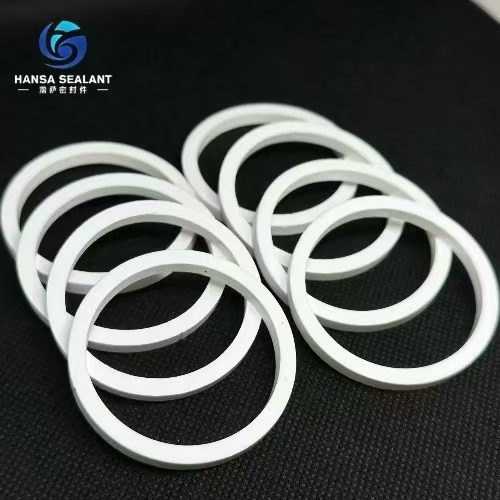
Expanded PTFE (ePTFE) gaskets, with their unique microporous structure imparting high resilience, low creep, and exceptional chemical inertness, have revolutionized sealing solutions by overcoming the drawbacks of traditional PTFE gaskets, such as cold flow and frequent re-tightening needs. From extreme temperatures and highly corrosive media to high-purity requirements and long-life demands, ePTFE gaskets are steadily replacing traditional sealing materials due to their comprehensive performance advantages, establishing a leading position in high-end industrial applications.


