
Productscpzx

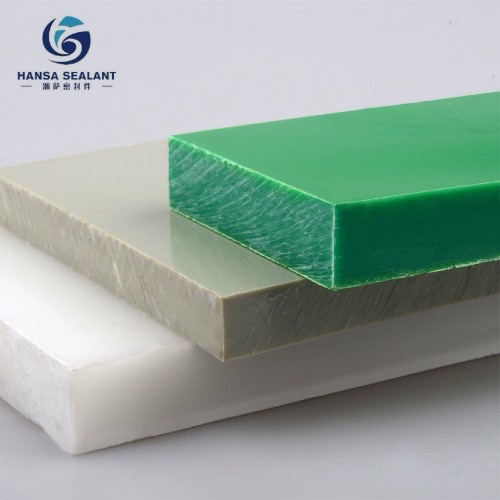
2. Compression Molding: Polyethylene raw material is placed into a mold, heated and pressurized in a hot press to melt, flow, and fill the cavity, then demolded after cooling. Suitable for producing small batches, large thickness (>50mm) sheets, or parts requiring specific inserts .
Material Types and Specification System
| Type | Molecular Weight/Characteristics | Typical Thickness/Diameter Range (mm) | Width × Length (mm) | Main Production Method | Main Application Areas |
| HDPE Sheet (General Grade) | MW ~300-500k, high crystallinity | 1 - 100 | 1000×2000 / 1300×3000 | Extrusion/Compression | Corrosion-resistant linings, cutting boards, insulating gaskets, tanks |
| UHMW-PE Sheet (Wear-Resistant Grade) | MW > 3 million, exceptional wear resistance | 5 - 120 | 1000×2000 / Custom | Compression/Extrusion | Chute liners, wear-resistant guides, hopper liners, ice rink dasher boards |
| Antistatic/Conductive Type | Carbon fiber/carbon black filled, surface resistance 10³-10⁶ Ω | 1 - 60 | 1000×2000 / 1220×2440 | Compression/Extrusion | Electronic production line fixtures, semiconductor trays, explosion-proof partitions |
| Food Grade/Medical Grade | Meets FDA/ISO10993 standards, high purity | 2 - 50 | 1000×2000 | Extrusion | Cutting boards, food conveyor belts, medical device components |
| Flexible PE Sheet (LDPE/LLDPE) | Low density, soft texture | 0.2 - 10 | Rolls/Sheets | Calendering/Blow molding | Sealing gaskets, cushioning pads, waterproofing membranes |
Technical Parameters and Performance Indicators
Physical & Mechanical Properties
| Property | HDPE Sheet Typical Value | UHMW-PE Sheet Typical Value | Test Standard/Reference |
| Density (g/cm³) | 0.94 - 0.96 | 0.93 - 0.94 | ASTM D792 |
| Tensile Strength (MPa) | 17 - 40 | 20 - 45 | ISO 527 |
| Elongation at Break (%) | > 350 | > 300 | ISO 527 |
| Flexural Strength (MPa) | 27 - 35 | 25 - 35 | ISO 178 |
| Impact Strength (Notched, kJ/m²) | No break - 20 | No break - >100 | ISO 179 |
| Shore Hardness (D) | 60 - 70 | 60 - 65 | ASTM D2240 |
| Coefficient of Friction | 0.20 - 0.30 | 0.10 - 0.20 | ASTM D1894 |
| Water Absorption (24h, %) | < 0.01 | < 0.01 | ASTM D570 |
Thermal & Electrical Properties
| Property | Typical Value/Range | Test Standard/Reference |
| Melting Point (℃) | 130 - 135 (HDPE) / 135 - 145 (UHMWPE) | DSC |
| Long-term Service Temp (Air, ℃) | -100 to 80 (HDPE) / -150 to 90 (UHMWPE) | — |
| Heat Deflection Temp (0.46MPa, ℃) | 60 - 80 | ASTM D648 |
| Coefficient of Linear Expansion (10⁻⁵/K) | 12 - 20 | ASTM D696 |
| Thermal Conductivity (W/m·K) | 0.40 - 0.45 | ASTM C177 |
| Dielectric Strength (kV/mm) | 45 - 65 | ASTM D149 |
| Volume Resistivity (Ω·cm) | > 10¹⁵ | ASTM D257 |
| Dielectric Constant (1MHz) | 2.3 - 2.4 | ASTM D150 |
Typical Application Areas
| Application Field | Specific Uses | Recommended Type | Key Requirements |
| Food Processing | Cutting boards, work surfaces, food conveyor belts, star wheels, screws | Food Grade HDPE | FDA certification, no leaching, easy cleaning |
| Bulk Material Handling | Hopper/chute liners, dump truck bed liners, vibratory feeder bases | UHMW-PE Wear-Resistant | Exceptional wear resistance, low friction, impact resistance |
| Semiconductor/Electronics | Wafer cleaning tanks, antistatic trays, PCB fixtures, jigs | Antistatic Type | Stable surface resistance, no particle shedding |
| Chemical Anti-Corrosin | Tank/reactor linings, acid/alkali baths, pipe gaskets, seals | HDPE General Grade | Chemical corrosion resistance, good weatherability |
| Cold Chain Logistics | Freezer box liners, freezer partitions, LNG storage seals | HDPE/UHMW-PE | No brittleness at -196°C, dimensional stability |
| Medical Devices | Artificial joints (acetabular cups), surgical instrument handles, prosthetic sockets | Medical Grade UHMW-PE | Biocompatibility, wear resistance, sterilizable |
| Port/Marine Machinery | Fenders, wear strips, bollard pads, crane sliders | UHMW-PE | Seawater corrosion resistance, impact resistance, self-lubrication |
| Sports & Recreation | Ice rink dasher boards, ski base material, slides, climbing walls | HDPE/UHMW-PE | Low-temperature resistance, weather resistance, UV resistance |
Processing, Joining, and Installation Guide
1. Machining
- Turning/Milling: High-speed steel or carbide tools are recommended. Due to the soft and tacky nature of PE, tools should have a large rake angle (15°-25°) and a relief angle of 8°-12°. High cutting speeds (200-500 m/min) and moderate feed rates (0.1-0.3 mm/rev) are suitable. Ensure adequate cooling or use air cooling to prevent chip melting and adhesion.
- Drilling: Use standard high-speed steel drills with a point angle of 90°-118°. A peck drilling cycle (2-3mm per peck) with chip removal is recommended. Water or compressed air can be used for cooling. The drilled hole diameter should be 0.1-0.2mm larger than the required final size to compensate for material shrinkage .
- Sawing: Band saws or circular saws are suitable. Use coarse, wide-set teeth for good chip clearance.
2. Joining and Assembly
- Hot Gas Welding: The most reliable method for joining PE sheets. Use a hot air gun or extrusion welder with filler rods made of the same PE material. Weld strength can reach 85%-95% of the parent material.
- Mechanical Fastening: Self-tapping screws or bolts can be used. Due to the softness and tendency for cold flow, it is recommended to use large washers or apply lubricant between the metal fastener and the PE surface.
- Insert Embedding: Metal inserts can be preheated to 100-120°C and pressed into pre-drilled holes, utilizing the cooling shrinkage of PE to form a secure interference fit.
3. Heat Treatment and Stress Relief
- For large thickness (>50mm) or high-precision components, annealing after rough machining is recommended: hold at 80-100°C in an oven for 2-4 hours (add 1 hour per 10mm of thickness), then cool slowly to room temperature in the oven. This can eliminate >60% of internal stresses, reducing the risk of deformation or cracking during subsequent use .
4. Installation Points
- Liner Installation: For hopper liners, bolt heads should be countersunk 2-3mm below the PE sheet surface to prevent material hang-up. Sheet joints should be chamfered or overlapped.
- Guide Rail Applications: When used for machinery guides, the mounting surface must be flat, and preload should be applied evenly to avoid localized stress concentrations.
Selection Decision Matrix
| Application Scenario | Primary Performance Requirement | Recommended PE Grade | Key Considerations |
| High-Wear Hopper Liner | Extreme wear resistance, low friction | UHMW-PE (MW > 5 million) | Select sheet verified by impact abrasion test, thickness ≥ 10mm |
| Direct Food Contact Cutting Board | Food safety, odorless, cut resistance | Food Grade HDPE (Natural) | Request FDA certification report from supplier, avoid recycled material |
| Semiconductor Cleanroom Fixture | Antistatic, low particle generation | Antistatic Type (Carbon Black Filled) | Surface resistance must be stable at 10⁶-10⁹ Ω and remain so after machining |
| Strong Acid/Alkali Tank Lining | Chemical resistance, low permeability | HDPE General Grade | Thickness ≥ 4mm, welds must pass airtightness test |
| Liquid Nitrogen Environment Support | Toughness at -196°C, low thermal conductivity | HDPE/UHMW-PE | Avoid highly filled modified grades to prevent low-temperature brittleness |
| Underwater Plain Bearing | Self-lubrication, low water absorption | UHMW-PE | Mating surface roughness Ra ≤ 1.6μm, design appropriate clearance |
Industry Customized Solutions
1. Liner for Large Off-Highway Truck Bodies
- Requirement: Withstand severe impact and abrasion from ore and coal, reduce vehicle dead weight, and minimize material adhesion.
- Solution: Use 20-30mm thick UHMW-PE wear-resistant sheets, heat-formed to shape, and secured to the truck body with countersunk bolts. Leverage PE's low friction for automatic material discharge, increasing payload by over 10%.
- Application: Heavy transport vehicles in mines and quarries.
2. Guide Rails for Photovoltaic Panel Cleaning Equipment
- Requirement: Long-term outdoor exposure to UV and humidity requires weather resistance, self-lubrication, and non-corrosiveness.
- Solution: Custom-extruded HDPE guide rail profiles with UV stabilization and smooth surfaces. Ensures quiet and stable operation with robotic cleaning arms.
- Application: Intelligent cleaning robots for large-scale photovoltaic plants.
3. Storage Rack Pads for Spent Nuclear Fuel Pools
- Requirement: Long-term immersion in borated deionized water requires radiation resistance, non-corrosiveness, and no abrasion to fuel rods.
- Solution: Use high-purity, additive-free UHMW-PE sheets, precision-machined into rack pads. Their radiation resistance (cumulative dose up to 10⁵ Gy) and extremely low ionic leachables ensure nuclear safety.
- Application: Fuel storage racks in nuclear power plants.
4. Conveyor Star Wheels for Bottled Beverage Lines
- Requirement: High-speed operation without scratching bottles, wear resistance, and no swelling upon contact with food-grade lubricants.
- Solution: Use food-grade HDPE sheets, formed by 5-axis water jet cutting or CNC engraving. Smooth surfaces effectively prevent bottle tipping and jamming.
- Application: Beverage filling and pharmaceutical packaging lines.
Storage and Maintenance
Storage Conditions
- Environment: Store in a cool, dry warehouse away from direct sunlight. Prolonged UV exposure can cause surface oxidation, discoloration, and degradation of mechanical properties .
- Placement: Sheets should be stored flat on level pallets or platforms to prevent bending deformation from long-term unsupported stacking. Stacking height for large sheets should not exceed 1 meter.
- Shelf Life: PE is chemically stable with no significant aging during storage. However, for sheets stored long-term (over 5 years), it is advisable to retest impact strength and surface hardness before critical use.
Usage and Maintenance
- Cleaning: General dirt can be cleaned with mild detergent and a soft cloth. For oil stains, alcohol or isopropyl alcohol can be used. Avoid cleaning with strong acids, strong alkalis, or organic solvents (e.g., acetone, toluene), as these can cause stress cracking or surface swelling .
- Repair: Superficial scratches can be repaired by sanding with fine-grit sandpaper or flame polishing (requires professional skill). Deep cracks or through-penetration damage cannot be repaired; the part must be replaced.
- Wear Inspection: For wear liners or guides, regularly inspect contact surfaces for wear. Although UHMW-PE is highly wear-resistant, prolonged exposure to high-speed abrasive flow will cause gradual material loss. Replacement is recommended when wear depth exceeds 1/3 of the original thickness.
- Antistatic Maintenance: The antistatic performance of antistatic PE sheets can degrade over time due to friction or contamination. Regular cleaning with mild detergent can help restore surface resistivity .
Development Trends
Technology Development Directions
1. Pushing Molecular Weight Limits: Advancing towards PE with molecular weights exceeding 10 million to further enhance wear resistance and impact strength, expanding applications in cutting-edge fields like artificial joints and ballistic protection.
2. Functional Compounding: Developing modified PE sheets with enhanced properties such as thermal conductivity (filled with graphene/BN), flame retardancy (with halogen-free additives), and high transparency, pushing beyond the limits of general-purpose plastics into specialized market segments.
3. Green and Circular Economy: Researching "green polyethylene" sheets based on bio-based ethylene (e.g., from sugarcane ethanol); simultaneously exploring efficient physical recycling and chemical depolymerization technologies for waste PE sheets to achieve material circularity.
4. Surface Engineering Innovations: Improving the printability and adhesiveness of PE sheet surfaces through flame treatment, corona treatment, or plasma treatment, enabling subsequent coating or lamination processes.
Market Application Expansion
1. Hydrogen Storage and Transport: Utilizing HDPE's low-temperature toughness and hydrogen barrier properties to develop liners for Type IV hydrogen storage tanks, replacing traditional metal liners to achieve lightweighting for hydrogen heavy-duty trucks.
2. Robotic Joints: The self-lubrication and wear resistance of UHMW-PE position it as a promising material for anti-friction bushings in rotational and linear joints of robots, especially humanoid robots, potentially replacing some powdered metal oil-impregnated bearings.
3. Ocean Ranching: UHMW-PE's exceptional resistance to seawater corrosion and biofouling makes it suitable for deep-sea aquaculture cage frames, floats, etc., withstanding typhoons and harsh marine environments.
4. Medical Implants: Highly cross-linked ultra-high molecular weight polyethylene (HXLPE) is the gold standard for artificial acetabular liners and tibial bearings in knee replacements. Next-generation antioxidant technologies extend its service life beyond 25 years.
Conclusion
PE sheets, particularly HDPE and UHMW-PE, serve as a paragon of "balancing rigidity and flexibility" among thermoplastics. With their excellent low-temperature toughness, unparalleled wear resistance, outstanding chemical stability, and food safety, they construct a vast application landscape ranging from general industrial protection to high-end medical implants. They are both the "wear-resistant armor" against sand and ore on bulk material conveyor lines, and the "sterile cutting board" safeguarding food safety on kitchen counters, and even the "artificial joints" extending life and vitality in the medical field. In the current era of "carbon neutrality" and advanced manufacturing, PE sheets are continuously pushing performance boundaries through molecular design, functional compounding, and green manufacturing, evolving towards longer life, greater intelligence, and enhanced environmental friendliness. Correct grade selection, scientific processing techniques, and targeted maintenance plans are the three core elements to fully unlocking the potential of PE sheet materials.


