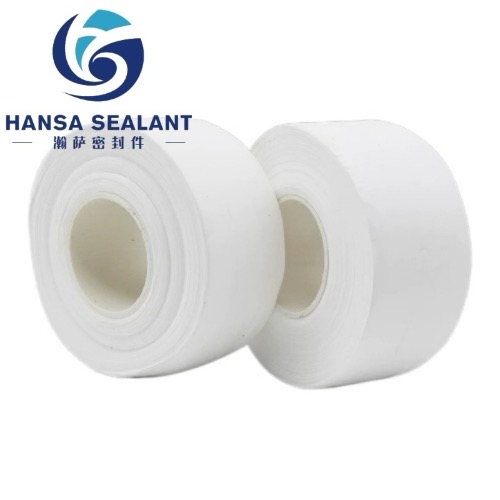
Introduction to PTFE Thread Seal Tape
PTFE Thread Seal Tape, commonly known as plumber's tape, sealing tape, or PTFE tape, is a thin, soft, ribbon-like sealing material primarily used for sealing pipe threaded connections to prevent joint leakage. Due to its low cost, ease of use, excellent sealing performance, and stable chemical properties, it has become an indispensable auxiliary sealing material in the plumbing, gas, chemical, and other industries.
Core Characteristics and Advantages
The exceptional performance of PTFE thread seal tape stems from its raw material, Polytetrafluoroethylene (PTFE), a high-performance polymer.
1. Exceptional Chemical Stability
Resistant to almost all strong acids, alkalis, oxidizing agents, and organic solvents, including aqua regia. This makes it suitable for sealing pipes carrying the vast majority of chemical media.
2. Excellent Temperature Resistance
Wide continuous operating temperature range, typically from -180°C to +260°C. Can withstand even higher temperatures for short periods. Suitable for both refrigeration systems and hot water systems (excluding high-temperature steam).
3. Excellent Flexibility and Moldability
Soft texture, easy to wrap. Under the pressure of tightening, it deforms to perfectly fill the microscopic gaps between threads, forming a dense seal.
4. Extremely Low Coefficient of Friction
Very smooth surface with an extremely low coefficient of friction. This not only makes wrapping easier but, more importantly, effectively "lubricates" the threads during tightening, making the process easier and allowing threads to be tightened more securely to avoid leakage due to excessive thread clearance.
5. Non-Stick Property
Exhibits typical non-stick characteristics; it will not bond to threads after use, facilitating future disassembly and maintenance.
6. Good Insulation Properties
An excellent electrical insulator, though its primary application here is for media sealing.
Main Application Fields
Residential/Civilian Applications:
Water Pipe Installation: Sealing threaded connections for faucets, angle valves, toilets, water heaters, etc., during home renovations.
Gas Pipes: Sealing threaded connections for liquefied petroleum gas (LPG) or natural gas pipelines (Important: Must use specialized, thicker yellow or gray tape designed for gas applications).
Industrial Applications:
Chemical Piping: Sealing threads on pipes, valves, and pumps conveying various chemicals.
Hydraulic Systems: Sealing threaded connections in medium-to-low pressure hydraulic equipment.
Compressed Air Systems: Sealing compressed air pipelines.
Usage Methods and Precautions
Correct Wrapping Method:
1. Clean the Threads: Ensure pipe threads are clean, dry, and free of oil, grease, and debris.
2. Determine Direction: Facing the pipe opening, wrap clockwise (in the same direction as thread tightening) so the tape doesn't unravel during tightening.
3. Choose Starting Point: Start wrapping from the second thread from the pipe end to prevent the leading edge of the tape from being pushed into the pipe, potentially causing blockage.
4. Wrap Under Tension: Slightly stretch the tape while wrapping to keep it tight. Overlap each wrap by 1/2 to 3/4 of its width, maintaining even tension.
5. Optimal Thickness: Typically, 15-25 wraps are sufficient (for 1/2" pipe). Do not wrap too thickly, as this may prevent proper tightening or crack the nut; nor too thinly, as it may fail to seal effectively.
6. Cut and Press: After the final wrap, tear the tape and press the end firmly onto the threads with a finger.
Important Precautions:
Not for Face-Seal Fittings: PTFE tape is only for thread sealing. If a joint relies on a gasket or O-ring for face sealing (e.g., most hose connections), using PTFE tape can actually compromise the seal.
Gas-Specific Use: Thicker, gas-grade tape (usually yellow or gray) must be used for sealing gas pipelines. Its pressure resistance and sealing performance are far superior to standard white tape, ensuring higher safety.
Pressure Limitations: Primarily used for static seals in low to medium-pressure applications. Not recommended for very high pressure, severe vibration, or frequent disassembly scenarios.
Compatibility Issues: Although PTFE has excellent chemical stability, it is not suitable for use with substances that react strongly with fluorides, such as liquid alkali metals or chlorine trifluoride, in extreme cases.
Common Specifications and Parameters
For a clearer understanding of its technical specifications, please refer to the table below:
| Characteristic |
Typical Value / Description |
Test Standard / Note |
|---|
| Primary Material |
Polytetrafluoroethylene (PTFE) |
Content typically ≥ 99% |
| Common Colors |
White (general purpose), Pink (medium density), Yellow/Gray (gas/high-strength) |
Color often indicates density and purpose |
| Common Widths |
12mm (½ inch), 19mm (¾ inch), 25mm (1 inch) |
12mm is most common |
| Common Thickness |
0.075mm - 0.1mm (Standard), 0.12mm - 0.2mm (Heavy-Duty/Gas) |
Gas-specific tape is thicker |
| Density |
1.0 - 1.2 g/cm³ |
|
| Tensile Strength |
≥ 10 MPa |
ASTM D638 |
| Elongation at Break |
≥ 200% |
ASTM D638 |
| Operating Temperature |
-180°C ~ +260°C |
Up to 300°C short-term |
| Pressure Resistance |
Depends on wrapping technique; generally suitable for systems ≤ 20 MPa |
Higher for heavy-duty types |
| Chemical Resistance |
Resistant to almost all chemicals and solvents |
Except for a few extreme oxidizing agents |
Summary
PTFE thread seal tape is an efficient, inexpensive, and widely used threaded sealing material. Its core value lies in utilizing the chemical inertness, temperature resistance, and low friction coefficient of PTFE to fill thread gaps and aid tightening. Correct selection (e.g., using heavy-duty tape for gas systems) and proper wrapping technique are key to achieving optimal sealing performance.