
Productscpzx

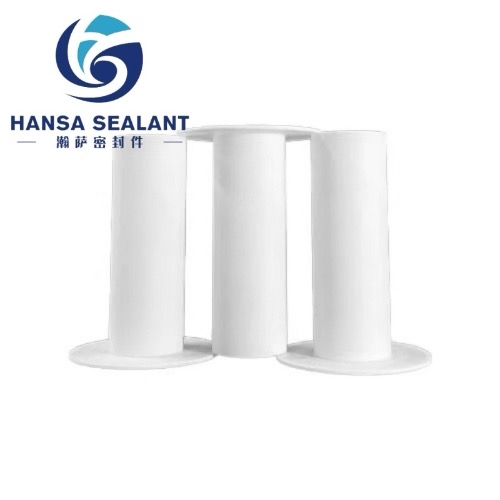
Introduction to PTFE Bushings
Product Overview
A PTFE bushing, typically referring to a Polytetrafluoroethylene (PTFE) Bushing or a sliding bearing primarily made of PTFE, is a core component installed in a mechanical housing bore to support rotating or sliding shafts. Unlike traditional metal bearings, PTFE bushings utilize their exceptional self-lubricating properties and low friction to enable smooth operation of moving parts, requiring little to no external lubrication. Hence, they are also known as "self-lubricating bearings" or "dry bearings."
Core Characteristics and Advantages
The performance of PTFE bushings stems from the PTFE material, which is often enhanced with various fillers.
Extremely Low Coefficient of Friction
PTFE has one of the lowest coefficients of friction among known solid materials (dynamic friction coefficient approximately 0.04-0.1). This results in low starting resistance, smooth operation, and reduced energy consumption.
Exceptional Self-Lubrication (Oil-Free Operation)
This is its most critical feature. PTFE material forms an ultra-thin transfer film on the mating surface during friction, creating a "PTFE-on-PTFE" lubrication effect. This completely eliminates the need for grease or oil, making it ideal for applications where lubrication is impossible or contamination must be avoided.
Excellent Chemical Corrosion Resistance
Similar to PTFE tape, PTFE bushings are resistant to almost all strong acids, alkalis, solvents, and oxidizing agents, allowing stable operation in harsh chemical environments.
Wide Operating Temperature Range
Typically maintains performance from -180°C to +260°C, with short-term tolerance for even higher temperatures.
Good Anti-Stick Properties and Aging Resistance
Non-stick surface prevents adhesion to the shaft. Excellent weatherability, does not age, leading to a long service life.
Electrical Insulation
Good insulating properties, suitable for applications requiring electrical insulation.
Common Fillers and Enhanced Properties
Pure PTFE is relatively soft, prone to wear and creep. Therefore, industrial applications commonly use fillers to improve its properties:
Glass Fiber (GF): Increases wear resistance and compressive strength.
Graphite (Gr): Further enhances self-lubrication and thermal conductivity.
Carbon Fiber (CF): Significantly improves wear resistance, compressive strength, and thermal conductivity; reduces thermal expansion.
Bronze (Bronze): Greatly improves thermal conductivity, compressive strength, and creep resistance, addressing PTFE's primary weaknesses.
Molybdenum Disulfide (MoS₂): Enhances lubricity, especially under high loads.
Polyimide (PI): Increases high-temperature resistance and mechanical strength.
Main Application Fields
The "oil-free, self-lubricating" nature of PTFE bushings makes them indispensable in the following sectors:
Food & Beverage Machinery: Filling machines, packaging machines, conveyors—where lubricant contamination of products must be avoided.
Chemical & Textile Machinery: Pumps, valves, agitators, textile dyeing/finishing equipment—exposed to chemicals or requiring corrosion resistance.
Automotive Industry: Chassis linkages, suspension systems, clutch bearings, universal joints—areas requiring maintenance-free operation or difficult to lubricate.
Office Equipment & Appliances: Copiers, printers, washing machines—components requiring quiet, oil-free operation.
Aerospace: Locations with extreme demands for lightweight, reliability, and maintenance-free operation.
Medical Equipment: Medical instruments, diagnostic devices—environments requiring clean, contamination-free operation.
Water Treatment & Marine: Submerged components, sluice gates—prone to corrosion or difficult to maintain.
Usage and Precautions
Installation: Typically press-fitted into a precision-machined housing bore to ensure tight contact and prevent rotation or creep during operation.
Shaft Requirements: High requirements for shaft hardness, surface finish, and tolerance. Shaft surfaces usually need to be hardened (HRC 45+) and polished to minimize wear.
Clearance: Appropriate fitting clearance must be calculated and reserved based on load, speed, and temperature.
Cleanliness: Ensure the shaft, housing bore, and bushing itself are clean and free of contaminants before installation.
Avoid In: Not suitable for applications with extremely high rotational speeds or sustained high loads (unless special filled grades are used). Other bearing types may be required in such cases.
Common Types and Parameter Comparison
Common Types and Characteristics of PTFE Bushings
| Type | Primary Material Composition | Core Characteristics | Typical Applications |
|---|---|---|---|
| Pure PTFE Bushing | 100% Polytetrafluoroethylene | Best chemical resistance, lowest friction coefficient, but prone to wear and creep | Light load, low speed, strong corrosion environments for sealing/support |
| PTFE + Bronze | PTFE + Bronze Powder + Lead Powder | Very high load capacity, good thermal conductivity, creep-resistant, suitable for high loads | Heavy machinery, automotive suspension, bridge/construction supports |
| PTFE + Glass Fiber | PTFE + Glass Fiber | Good wear resistance, high compressive strength, cost-effective | Chemical pumps/valves, general industrial machinery, medium-load applications |
| PTFE + Carbon Fiber | PTFE + Carbon Fiber | Excellent wear resistance, high mechanical strength, good thermal conductivity | High-speed applications, high-wear resistance requirements, aerospace |
| PTFE + Graphite | PTFE + Graphite | Enhanced self-lubrication, improved high-temperature resistance | Sealing and bearings in high-temperature environments |
Performance Parameter Table
| Characteristic | Test Standard | Unit | Typical Value Range | Remarks |
|---|---|---|---|---|
| Density | ASTM D792 | g/cm³ | 2.8 - 3.5 (varies by formulation) | Pure PTFE is ~2.2 |
| Max. Static Load | - | MPa (N/mm²) | 100 - 250+ | Bronze-filled type is highest |
| Max. PV Value | - | MPa·m/s | 0.4 - 1.2 (dry) | Limit value for frictional work |
| Friction Coefficient (Dry) | ASTM D1894 | - | 0.04 - 0.15 | Depends on shaft material, surface finish, load |
| Wear Factor (K) | - | mm³/(N·m·10⁶) | 10 - 40 | Lower value indicates better wear resistance |
| Operating Temperature | - | °C | -180 to +260 | Up to 280°C short-term |
| Coeff. of Linear Thermal Expansion | ASTM E831 | 10⁻⁵/K | 5 - 12 | About 5-10 times that of steel; thermal clearance must be considered in design |
| Thermal Conductivity | ASTM C177 | W/m·K | 0.4 - 1.5 | Significantly improved with fillers; pure PTFE is only 0.25 |
Summary
PTFE bushings are key components that solve bearing challenges in special operating conditions with their three core characteristics: self-lubrication, corrosion resistance, and low friction. Through material technology innovation (adding various fillers), they greatly improve the mechanical weaknesses of PTFE while retaining its advantages, playing an irreplaceable role in numerous advanced and industrial fields where traditional grease lubrication cannot be used. Selecting the appropriate material formulation requires comprehensive consideration of load, speed, temperature, medium, and environmental requirements.


