
Productscpzx

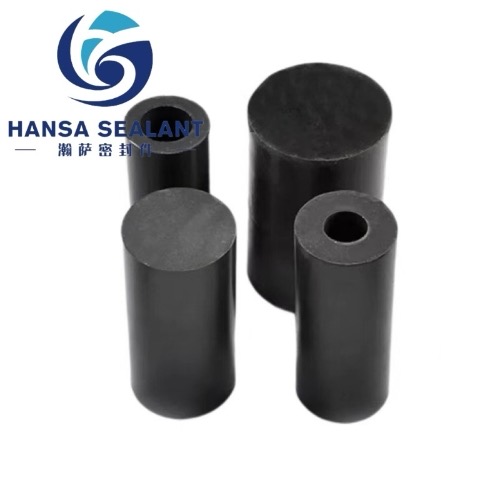
Introduction to Carbon-Filled PTFE (CF/PTFE) Rod
Carbon-filled PTFE rod, fully known as Carbon Fiber Reinforced Polytetrafluoroethylene Rod, is a composite high-performance engineering plastic rod manufactured through processes such as compression molding and sintering. It consists of a PTFE (Polytetrafluoroethylene) matrix uniformly reinforced with carbon fiber (CF) fillers.
This is not a simple physical mixture but a material-level combination that integrates the excellent properties of PTFE with the high strength of carbon fibers, resulting in a novel functional material whose performance far exceeds that of pure PTFE. It is specifically designed to address the mechanical shortcomings of pure PTFE.
Core Characteristics and Advantages
The exceptional performance of CF/PTFE rods stems from the complementary strengths of the two materials:
Very High Mechanical Strength and Stiffness
The addition of carbon fibers significantly mitigates the poor mechanical properties of pure PTFE. Its compressive strength, flexural strength, and rigidity (modulus) are improved by several to more than ten times, enabling it to withstand high loads without deformation.
Exceptional Wear Resistance
This is one of its most notable advantages. The high hardness and wear resistance of carbon fibers act as a reinforcing skeleton, effectively resisting wear. Its wear resistance is hundreds to thousands of times better than that of pure PTFE, making it one of the most wear-resistant plastic materials.
Extremely Low Friction Coefficient and Self-Lubrication (Inherited from PTFE)
Retains the core advantages of PTFE, with an extremely low friction coefficient (0.1-0.2). It operates smoothly without the need for external lubricants.
Good High-Temperature Resistance and Dimensional Stability
Inherits PTFE's broad temperature range (-180°C to +260°C). The addition of carbon fibers significantly reduces the coefficient of thermal expansion and improves thermal conductivity, giving it far superior dimensional stability under temperature fluctuations compared to pure PTFE and reducing "cold flow."
Excellent Chemical Resistance (Inherited from PTFE)
Resistant to almost all strong acids, strong alkalis, organic solvents, and other chemical media (except for a very few substances like molten alkali metals and fluorine gas).
Important Characteristics to Note:
Electrical Conductivity: The addition of carbon fibers imparts electrical and thermal conductivity to the material; it is no longer an insulator. This can be utilized for static dissipation but also means it cannot be used in applications requiring insulation.
Color: Typically appears black.
Machinability: While it can be machined (turned, milled, drilled), it causes severe tool wear. The use of carbide or diamond tools is recommended.
Main Application Areas
CF/PTFE rods are typically machined into various wear-resistant components and used in:
Mechanical Industry:
High-Performance Bearings: Used for bearings and bushings in oil-free, low-speed, high-load, and highly corrosive environments.
Guide Rails and Slides: Wear-resistant guide rails and slide pads for machine tools and automation equipment.
Seals: Piston rings, packing rings, valve plates, etc., especially in media containing abrasives.
Gears and Cams: Lightweight, oil-free lubrication transmission components.
Aerospace and Automotive:
Lightweight wear-resistant components in aircraft and racing car engines, piston rings for automotive air conditioning compressors, etc.
Chemical and Textile Machinery:
Wear-resistant parts for pumps and valves, yarn guides, friction blocks in textile machinery, etc., capable of resisting both chemical corrosion and fiber abrasion.
Electronics:
Utilizes its conductivity for components requiring anti-static properties or electromagnetic shielding.
Technical Parameters & Data Table
For a more intuitive understanding of its performance enhancement, please refer to the following comparison table with pure PTFE rod:
Performance Comparison: CF/PTFE Rod vs. Pure PTFE Rod
| Characteristic | Test Standard | Unit | Pure PTFE Rod | CF/PTFE Rod (20% CF) | Performance Improvement |
|---|---|---|---|---|---|
| Density | ASTM D792 | g/cm³ | 2.15 - 2.20 | 1.9 - 2.0 | Lighter |
| Compressive Strength | ASTM D695 | MPa | ~12 | 70 - 90 | ~6-7 times higher |
| Flexural Strength | ASTM D790 | MPa | ~20 | 40 - 60 | ~2-3 times higher |
| Flexural Modulus | ASTM D790 | MPa | ~600 | 2000 - 3000 | ~4-5 times higher |
| Coefficient of Friction | ASTM D1894 | - | 0.05 - 0.10 | 0.10 - 0.20 | Slightly higher, still very low |
| Wear Volume | ASTM D1044 | mg | Very high (as baseline) | Very low | Wear resistance improved by hundreds of times |
| Heat Deflection Temp. | ASTM D648 | °C | 55 (at 0.45 MPa) | > 100 (at 0.45 MPa) | Significantly improved |
| Coeff. of Linear Thermal Expansion | ASTM E831 | 10⁻⁵/K | 10 - 15 | 3 - 5 | Significantly reduced, better dimensional stability |
| Volume Resistivity | ASTM D257 | Ω·cm | >10¹⁸ | 10² - 10⁶ | Changed from insulator to conductor |
CF/PTFE Rod Selection Guide
| Characteristic | Description | Application Implication |
|---|---|---|
| Ultra-High Wear Resistance | Its core advantage | First choice for applications involving wear, such as bearings, guide rails. |
| High Mechanical Strength | Load-bearing capacity far exceeds pure PTFE | Used for structural components subjected to higher loads. |
| Electrical & Thermal Conductivity | Can dissipate static electricity, aids heat dissipation | Used for anti-static applications; cannot be used for insulation. |
| Chemical Corrosion Resistance | Retains PTFE's advantages | Can be used for wear parts in corrosive environments. |
| Color | Black | Easy to distinguish from other materials. |
Conclusion
The Carbon-Filled PTFE (CF/PTFE) rod is an engineering material achieved through composite modification technology, representing a synergistic "combination of strengths." Its fundamental purpose is to serve as a solution addressing the mechanical performance deficiencies of pure PTFE.
Its positioning is very clear:
When you need the corrosion resistance, high-temperature resistance, and self-lubrication of PTFE...
But the operating conditions also demand higher wear resistance, compressive strength, and creep resistance...
Then, CF/PTFE rod is your ideal choice.
It is a functionally oriented material, commonly used in critical components with extremely high demands on friction and wear performance. Although its cost and machining difficulty are higher, the extended service life and high reliability it provides make it indispensable in high-end industrial fields. Special attention must be paid during material selection to whether its electrical conductivity is compatible with your application scenario.


