
Productscpzx

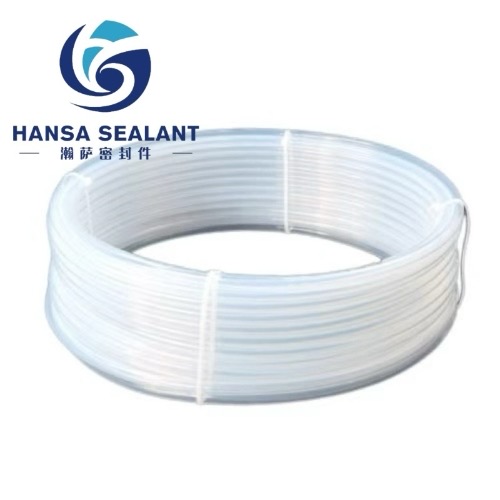
Introduction to Semi-Transparent PTFE Tubing
Semi-transparent PTFE tubing is a type of tubing made from polytetrafluoroethylene (PTFE) material that possesses a certain degree of transparency. Its "semi-transparent" characteristic allows for the observation of fluid conditions inside the tube while retaining all the exceptional properties of PTFE. It is a specialty tubing that combines high performance with practicality.
This semi-transparent property typically originates from unique processing techniques (such as paste extrusion) and the material's own microstructure, rather than through the addition of additives. Therefore, it does not compromise the chemical purity of PTFE.
Core Characteristics and Advantages
Semi-transparent PTFE tubing perfectly inherits the core advantages of PTFE and adds visibility:
Exceptional Chemical Stability
Resistant to almost all strong acids, strong alkalis, strong oxidizers, and organic solvents, including aqua regia and hydrofluoric acid. This is its primary value as tubing.
Exceptional Temperature Resistance
Extremely wide operating temperature range, from -200°C to +260°C, suitable for high-temperature heating and low-temperature cooling processes.
High Chemical Purity and Low Contamination
Inherently non-leaching and non-extracting, making it ideal for conveying high-purity chemicals, semiconductor chemicals, pharmaceutical intermediates, and ultrapure water. It does not contaminate the fluid.
Semi-Transparency (Core Added Value)
Allows operators to directly observe fluid flow state, color changes, presence of bubbles, and liquid level inside the tube. This is crucial for laboratory research, small-batch precision dosing, and process monitoring.
Flexibility, Non-Stick Properties, and Low Friction Coefficient
Easy to install and bend. The inner wall is extremely smooth with minimal frictional resistance, preventing material buildup, ensuring smooth fluid transfer, and easy cleaning.
Manufacturing Process
Semi-transparent PTFE tubing is typically manufactured using the Paste Extrusion process:
Paste Preparation: PTFE fine powder (dispersion resin) is mixed with an appropriate amount of organic lubricant (e.g., solvent naphtha) to form a paste.
Extrusion (Paste Extrusion): The paste is pre-formed into a billet, placed into an extruder, and forced under pressure through a die with a tubular orifice.
Drying: The extruded tubing passes through a heating zone to remove the lubricant.
Sintering: Sintered at high temperature (above PTFE's melting point of 327°C), causing the PTFE particles to fuse into a continuous, robust whole.
Cooling: Cooled and set into the final product.
This process produces tubing with uniform wall thickness and an extremely smooth inner surface.
Main Application Fields
The value of semi-transparent PTFE tubing is irreplaceable in the following fields requiring both corrosion resistance and visibility:
Semiconductor & Solar PV Industry:
Conveying ultra-high purity chemical slurries (e.g., CMP Slurry), high-purity acids/alkalis, photoresists, etc. Transparency facilitates bubble observation and elimination.
Chemical & Petrochemical Laboratories:
Setting up experimental apparatus, conveying various corrosive reagents. Researchers can observe fluid flow, color changes, and phase separation in real-time.
Analytical Instrumentation:
Used as transfer lines in instruments like chromatographs (e.g., HPLC), flow analyzers, etc., offering both solvent resistance and ease of observation and troubleshooting.
Pharmaceutical & Biotechnology:
Used in drug R&D and pilot processes to convey solutions sensitive to metal ions, cell culture media, etc., ensuring sterility and non-contamination, while allowing process monitoring.
Specialty Chemical Production:
Used in transfer and metering systems for small-batch, high-value fine chemical products.
Technical Parameters & Data Table
The following table lists typical performance parameters for semi-transparent PTFE tubing:
Typical Performance Parameters of Semi-Transparent PTFE Tubing
| Characteristic | Test Standard | Unit / Description | Typical Value / Remarks |
|---|---|---|---|
| Primary Material | - | Polytetrafluoroethylene (PTFE) Dispersion Resin | Very High Chemical Purity |
| Appearance | - | White, Semi-Transparent | Transparency depends on wall thickness; thinner walls are more transparent |
| Temperature Range | - | °C | -200 to +260 (short-term up to 300 possible) |
| Compatible Media | - | - | Almost all chemicals (except molten alkali metals, fluorine gas, etc.) |
| Working Pressure | - | MPa | Typically used for low-pressure or atmospheric systems |
| Dielectric Strength | ASTM D149 | kV/mm | 20 - 60 |
| Volume Resistivity | ASTM D257 | Ω·cm | >10¹⁸, Excellent electrical insulation |
| Inner Surface | - | - | Extremely smooth, non-stick |
| Common Colors | - | - | Semi-transparent, Milky white |
| Key Advantages | - | - | Strong corrosion resistance, High temperature resistance, High purity, Fluid visibility |
Selection and Usage Notes
Dimensions: Specify Inner Diameter x Outer Diameter (e.g., Φ2mm x Φ4mm) or Inner Diameter x Wall Thickness.
Bend Radius: Should not be bent below its minimum bend radius to avoid kinking or damage.
Connection Methods: Typically sealed using PTFE or PFA fittings; flanged connections are also possible. Avoid over-tightening with metal clamps to prevent cutting the tube wall.
Pressure Requirements: Do not exceed pressure ratings. It is primarily for low-pressure transfer, not high-pressure piping.
Installation Support: As a flexible hose, appropriate support and securing are needed for long-distance runs.
Conclusion
Semi-transparent PTFE tubing is the "premium" product within the PTFE tubing family. It perfectly resolves the application conflict of requiring both "high corrosion resistance" and "visual observation capability."
It is not merely a simple transfer line but a system component integrating multiple functions: corrosion resistance, high-temperature resistance, high purity, and process visibility.
Its core value lies in:
Safety: Enables visual monitoring of internal conditions when handling hazardous chemicals.
Convenience: Facilitates experimental setup, debugging, and troubleshooting.
Reliability: Ensures process purity and stability.
When your application involves high-purity, highly corrosive media and requires visual monitoring of fluid state, semi-transparent PTFE tubing is almost the only choice. It is commonly found in high-end laboratories, semiconductor, biopharmaceutical, and other fields with extremely stringent requirements for process and materials.


