
Productscpzx

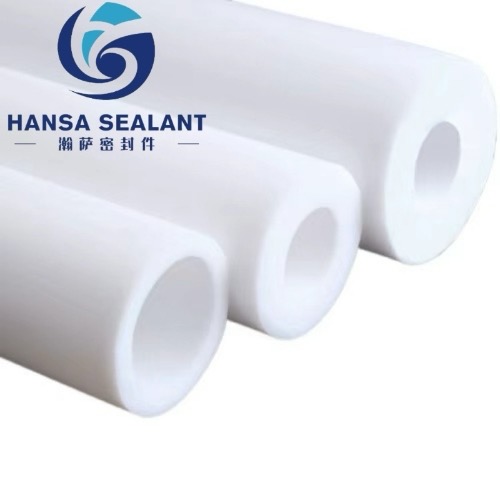
Introduction to Polytetrafluoroethylene (PTFE) Sleeves
Polytetrafluoroethylene (PTFE) sleeves are tubular or cylindrical components machined from PTFE material. They fully leverage the numerous exceptional properties of PTFE and are widely used as functional parts in areas such as insulation, corrosion resistance, anti-adhesion, wear resistance, and sealing.
Sleeves typically have precise inner and outer diameter dimensions and can be manufactured through processes such as molding/sintering followed by machining, extrusion/sintering, or rolling/sintering.
Core Characteristics and Advantages
The performance of PTFE sleeves fully inherits the inherent advantages of PTFE material:
Extremely High Chemical Stability
Resistant to almost all strong acids, strong alkalis, strong oxidizing agents, and organic solvents, including aqua regia. This makes PTFE sleeves an ideal choice for protecting equipment components in corrosive environments.
Excellent High and Low-Temperature Resistance
Can operate long-term within an extreme temperature range of -200°C to +260°C with stable performance.
Extremely Low Friction Coefficient and Excellent Non-Stick Properties
Very low coefficient of friction (approx. 0.04-0.1) and extremely low surface energy, making it difficult for any substance to adhere to its surface. This makes sleeves highly suitable as wear-resistant bushings or anti-adhesive sheaths.
Excellent Electrical Insulation
Maintains very high insulation resistance and dielectric strength across various frequencies and in humid environments, making it a high-performance insulating material.
Self-Lubricating
Provides smooth sliding without the need for additional lubricants, suitable for oil-free lubrication or applications where oil contamination is prohibited.
Aging and Weather Resistance
Highly stable against UV light, ozone, and oxidation, resulting in a long service life.
Main Application Fields
Based on the above properties, PTFE sleeves play a key role in the following scenarios:
As Insulating Sleeves:
Electrical & Electronics: Used to protect capacitors, resistors, cable joints, high-frequency communication device components, etc., providing high-grade insulation.
High-Voltage Environments: Used as insulating bushings in high-voltage cable terminations, transformers, and switchgear.
As Anti-Adhesive, Wear-Resistant Bushings/Liners:
Chemical Equipment: Installed as liners on the inner walls of reactors, mixing tanks, and pipes to prevent material adhesion and resist corrosion.
Mechanical Fields: Used as oil-free lubricated bearings or guide bushings, especially in the presence of water or corrosive media.
Food & Pharmaceutical: Used in equipment areas where raw material adhesion must be prevented, allowing for easy cleaning (requires food-grade PTFE).
As Protective Sleeves:
Sensor Protection: Slipped over temperature sensors, level sensors, etc., allowing them to function normally in corrosive media.
Mechanical Part Protection: Slipped over shafts, rods, and other parts to prevent corrosion or wear.
As Sealing Element Carriers:
Sometimes used as support skeletons or guide sleeves for V-ring packing, lip seals, etc.
Common Types and Reinforced Modifications
To overcome the mechanical shortcomings of pure PTFE sleeves, filler modifications are often employed:
| Type | Material Composition | Main Enhanced Properties | Typical Applications |
|---|---|---|---|
| Pure PTFE Sleeve | 100% PTFE | Highest chemical purity, best dielectric properties | High-purity insulation, liners for highly corrosive environments |
| Glass Fiber Reinforced Sleeve | PTFE + Glass Fiber | Wear resistance, compressive strength, creep resistance | Wear-resistant bearings, guide bushings |
| Carbon Fiber Reinforced Sleeve | PTFE + Carbon Fiber | Wear resistance, mechanical strength, thermal conductivity | High-speed, high-load bearings, precision components |
| Graphite Reinforced Sleeve | PTFE + Graphite | Self-lubrication, thermal conductivity | Oil-free lubricated bearings |
| Bronze Filled Sleeve | PTFE + Bronze Powder | Compressive strength, thermal conductivity, creep resistance (most significant) | High-load bearings for heavy machinery |
Technical Parameters & Data Table
The following table lists typical performance parameters for pure PTFE sleeves:
Typical Performance Parameters for PTFE Sleeves (Pure Material)
| Characteristic | Test Standard | Unit | Typical Value Range | Remarks |
|---|---|---|---|---|
| Density | ASTM D792 | g/cm³ | 2.14 - 2.20 | |
| Tensile Strength | ASTM D638 | MPa | 20 - 35 | Mechanical strength is moderate |
| Elongation at Break | ASTM D638 | % | 200 - 400 | |
| Coefficient of Friction | ASTM D1894 | - | 0.04 - 0.1 | Very low |
| Continuous Service Temperature | - | °C | -200 to +260 | Core Advantage |
| Heat Deflection Temperature | ASTM D648 | °C | 55 (at 0.45 MPa) | |
| Volume Resistivity | ASTM D257 | Ω·cm | >10¹⁸ | Excellent insulator |
| Dielectric Strength | ASTM D149 | kV/mm | 20 - 60 | |
| Water Absorption | ASTM D570 | % | <0.01 | Almost non-absorbent |
| Limiting Oxygen Index (LOI) | ASTM D2863 | % | ~95 | Flame-retardant |
Selection Guide by Function
| Primary Requirement | Preferred Material Type | Rationale |
|---|---|---|
| Ultra-high Insulation, Strong Corrosion | Pure PTFE | Highest chemical purity, best dielectric properties |
| Wear Resistance, Creep Resistance | Glass Fiber / Carbon Fiber Filled PTFE | Significantly improves hardness, wear resistance, and compressive strength |
| High Load, High Thermal Conductivity | Bronze Filled PTFE | Greatly improves compressive strength and thermal conductivity; best creep resistance |
| Oil-Free Lubrication | Graphite Filled PTFE |


