
Productscpzx

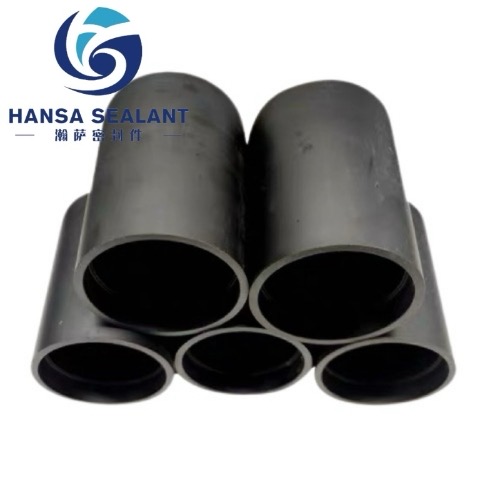
Introduction to Black Molybdenum Disulfide Cast Nylon Tube
This is a type of nylon tubing manufactured through the monomer casting process. Its core material is modified nylon with molybdenum disulfide (MoS₂) added as a solid lubricant and reinforcing filler, typically presenting a black color.
Core Components Analysis
Base Material: Cast Nylon (MC Nylon)
Unique Process: Unlike common extruded nylon tubes, cast nylon is produced via in-situ polymerization. Molten nylon monomer (caprolactam) is directly poured into a mold where polymerization occurs to form the final shape. This process enables the manufacture of products with very large wall thicknesses and oversized dimensions, which are difficult to achieve through extrusion.
Superior Performance: Cast nylon has a higher molecular weight (approximately twice that of conventional Nylon 6), resulting in far better mechanical strength, toughness, wear resistance, and dimensional stability compared to standard Nylon 6.
Key Additive: Molybdenum Disulfide (MoS₂)
Solid Lubrication: Molybdenum disulfide is a renowned solid lubricant with a layered structure. The bonding between layers is weak, giving it an extremely low coefficient of friction (as low as 0.05~0.09). When added to nylon, it forms a lubricating film on friction surfaces, significantly reducing the material's coefficient of friction and wear rate.
Reinforcement and Modification: The addition of MoS₂ not only provides lubrication but also acts as a nucleating agent. It refines the crystalline structure of the nylon, increases its crystallinity, and thereby enhances the nylon's rigidity, hardness, heat deflection temperature, and dimensional stability.
Color Source: Molybdenum disulfide itself is blackish-gray, which gives the otherwise slightly yellowish cast nylon a dark gray or black color.
Basic Performance Data Table
| Performance Indicator | Unit | Black MoS₂ Cast Nylon (MC 901+MoS₂) | Standard Nylon 6 (PA6) | Test Standard |
|---|---|---|---|---|
| Density | g/cm³ | 1.15 - 1.16 | 1.13 - 1.15 | ASTM D792 |
| Tensile Strength | MPa | 85 - 100 | 70 - 85 | ASTM D638 |
| Flexural Strength | MPa | 120 - 150 | 90 - 110 | ASTM D790 |
| Impact Strength (Unnotched) | kJ/m² | 100 - 150 (No break) | 50 - 80 | ASTM D256 |
| Rockwell Hardness | - | M80 - M95 | M80 - M90 | ASTM D785 |
| Coefficient of Friction (vs. Steel) | - | 0.05 - 0.15 | 0.25 - 0.40 | ASTM D1894 |
| Heat Deflection Temp. (1.82 MPa) | °C | 150 - 190 | 60 - 80 | ASTM D648 |
| Continuous Service Temperature | °C | -40 to +100 | -40 to +80 | - |
| Water Absorption (24h) | % | 0.6 - 0.9 | 1.3 - 1.8 | ASTM D570 |
| Coeff. of Linear Thermal Expansion | ×10⁻⁵/°C | 7 - 9 | 8 - 10 | ASTM D696 |
Main Performance Characteristics (Advantages)
Due to the combination of the above material and process, black MoS₂ cast nylon tubes possess the following outstanding advantages:
Extremely High Mechanical Strength and Toughness: High load-bearing capacity, can withstand high loads and impacts, resistant to breakage.
Exceptional Wear Resistance and Self-Lubrication: This is its core feature. Low coefficient of friction allows operation with little or no lubricating oil, making it particularly suitable for "oil-free lubrication" or "dry friction" conditions. Service life far exceeds that of ordinary steel, copper, or plastic tubes.
Excellent Chemical Stability: Resistant to alkalis, alcohols, hydrocarbon solvents, and oils (e.g., engine oil, gasoline). However, resistance to strong acids and phenols is poor.
Low Water Absorption: Compared to standard nylon, MC nylon has lower water absorption, meaning dimensions are less affected by humidity changes, resulting in better dimensional stability.
Light Weight: Density is about 1.15-1.16 g/cm³, only 1/7 that of copper and 1/8 that of steel, facilitating installation and handling.
Low Noise: Operation generates less noise than metal components.
Easy to Machine: Can be machined (turning, milling, drilling, planing) to produce various complex parts.
Common Application Fields
Based on its properties, it is widely used in applications requiring heavy loads, wear resistance, and self-lubrication. It typically serves as a structural component such as bushings, sliders, guide rails, gears, bearing cages, or piston rings, rather than merely a "pipeline" for fluid transport.
Metallurgical & Mining Machinery: High-load rolling mill bearings, couplings, gears, conveyor idlers.
Paper Machinery: Vacuum box covers, dewatering equipment, press roll bearings.
Marine Industry: Hatch cover slides, sliders, bearings, rudder shaft sleeves, and other seawater corrosion-resistant parts.
Textile Machinery: High-speed shuttles, picking sticks, gears, bearings (self-lubrication prevents contamination of textiles).
Hydroelectric Power Plants: Bushings, seal rings for hydroelectric generator sets.
Others: Construction machinery, automotive manufacturing, sports equipment, etc.
Comparison with Similar Products
Vs. Standard Nylon Tube (Extruded): Superior in all aspects: mechanical properties, wear resistance, dimensional stability. Can be used to make thicker, larger components.
Vs. Polytetrafluoroethylene (PTFE) Tube: PTFE has a lower friction coefficient, but its mechanical strength, rigidity, and wear resistance are far inferior to MoS₂ MC nylon. MC nylon is more suitable for high-load applications.
Vs. Ultra-High Molecular Weight Polyethylene (UHMWPE) Tube: UHMWPE has excellent wear resistance and high impact strength, but its heat deflection temperature is low and it lacks rigidity (softer). MC nylon offers better rigidity, heat resistance, and creep resistance.
Conclusion
Black Molybdenum Disulfide Cast Nylon Tube is not a standard fluid transport pipe but a high-performance engineering plastic structural material. Through the unique casting process and the reinforcement/lubrication modification provided by MoS₂, it perfectly combines the advantages of high strength, high wear resistance, self-lubrication, and chemical stability. It is an ideal choice for solving mechanical wear problems under conditions of heavy loads, low speeds, and oil-free lubrication.
When selecting this material, suitability must be evaluated based on specific load, speed, operating temperature, and medium.


