
Productscpzx

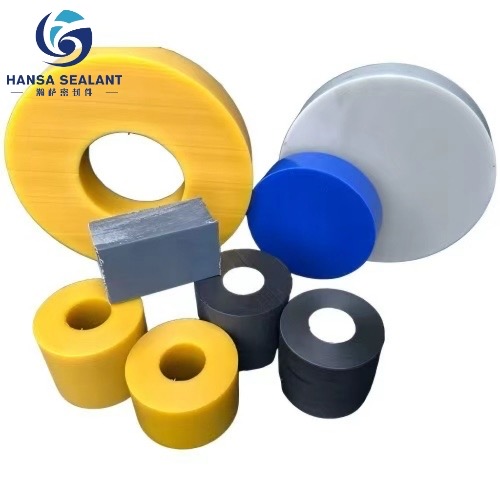
Professional Introduction to Filled Nylon Products
Definition
Filled nylon products are composite material products made from nylon (polyamide, PA) as the matrix resin, modified by adding inorganic or organic fillers (such as glass fiber, carbon fiber, mineral powder, flame retardants, etc.). Filling modification can significantly enhance the mechanical properties, thermal properties, or functionality of nylon to meet specific industrial demands.
Material Characteristics
High Strength and Rigidity: For example, adding 30% glass fiber can increase nylon's tensile strength and flexural modulus by 2-3 times.
Enhanced Heat Resistance: The heat deflection temperature (HDT) of filled nylon can exceed 200°C (e.g., PA66+GF).
Improved Dimensional Stability: Reduces water absorption, minimizing product shrinkage and deformation.
Functional Expansion: Imparts properties such as flame retardancy, antistatic capability, and wear resistance through fillers (e.g., adding mica to improve insulation).
Common Filler Types
Filler Type
Primary Effect
Typical Application Scenarios
Glass Fiber (GF)
Improves strength, rigidity, heat resistance
Automotive components, gears, structural parts
Carbon Fiber (CF)
Lightweight, high conductivity, high strength
Aerospace, sports equipment
Mineral Fillers (Talc, Calcium Carbonate)
Reduces cost, improves dimensional stability
Appliance housings, industrial parts
Flame Retardants (Brominated, Halogen-free)
Achieves UL94 V0 flame retardant rating
Electronic & electrical appliances, EV charger components
Production Processes
Compounding Modification: Nylon and fillers are melt-compounded using a twin-screw extruder to produce modified material pellets.
Injection Molding: Filled nylon pellets are processed by an injection molding machine into complex-shaped products (requires control of mold temperature and injection speed).
Post-Processing: Annealing or conditioning treatments are performed when necessary to eliminate internal stress.
Application Fields
Automotive Industry: Engine peripheral components, fuel system parts (oil-resistant, high-temperature resistant).
Electronics & Electrical Appliances: Circuit breakers, connectors (flame retardant, insulating).
Mechanical Engineering: Gears, bearings (wear-resistant, self-lubricating).
Consumer Goods: Tool handles, sports equipment (lightweight, high toughness).
Industry Trends
Green Development: Development of bio-based nylons (e.g., PA56) and recyclable fillers.
High-Performance: Use of nano-fillers (e.g., graphene) to enhance the overall properties of composites.
Intelligent Manufacturing: Utilizing AI to optimize filler ratios and process parameters, reducing production costs.
Areas of Professional Study
Polymer Materials Science and Engineering
Composite Material Modification Technology
Plastic Molding and Processing Technology
Material Performance Testing and Characterization (e.g., DSC, FTIR, mechanical testing)
Basic Definitions
Category
Description
Material Composition
Matrix Resin: Nylon (PA6, PA66, PA12, etc.) + Fillers (Inorganic/Organic) + Additives (optional)
Modification Purpose
Enhance mechanical properties, thermal properties, dimensional stability, or impart special functions (e.g., flame retardancy, conductivity)
Common Filler Types and Effects
Filler Type
Typical Loading
Primary Effects
Pros and Cons
Glass Fiber (GF)
10%-50%
Improves strength, rigidity, heat resistance
Cost-effective, but may increase surface roughness
Carbon Fiber (CF)
5%-30%
Lightweight, high conductivity, high strength
High cost, requires uniform dispersion
Mineral Filler (Talc)
10%-40%
Reduces cost, improves dimensional stability
Lowers cost, improves stability, but can reduce toughness
Flame Retardant (Halogen-free)
5%-20%
Achieves UL94 V0/V1 flame retardant rating
Eco-friendly, but may slightly reduce mechanical properties
Typical Performance Comparison (Using PA6 as Example)
Performance Indicator
Pure PA6
PA6 + 30% GF
PA6 + 20% Mineral
Test Standard
Tensile Strength (MPa)
70-80
150-180
60-70
ISO 527
Flexural Modulus (GPa)
2.5
6.0-8.0
3.0-3.5
ISO 178
HDT (°C, 1.82 MPa)
60-70
210-220
80-90
ISO 75-1/-2
Water Absorption (24h, %)
1.5-2.0
0.5-0.8
0.8-1.2
ISO 62
Production Process Flow
Process Step
Key Parameters
Equipment/Technology
Precautions
Compounding & Pelletizing
Temp: 230-280°C; Screw Speed: 200-400 rpm
Twin-Screw Extruder
Fillers require pre-drying to avoid agglomeration
Injection Molding
Mold Temp: 80-120°C; Inj. Pressure: 60-100 MPa
Injection Molding Machine (with wear-resistant screw design)
Control cooling rate to minimize warpage
Post-Processing
Conditioning: Boiling water/steam for 2-4h
Constant Temperature/Humidity Chamber
Balances moisture content, stabilizes dimensions
Application Fields and Case Studies
Industry
Typical Products
Core Requirements
Recommended Filling Solution
Automotive
Intake Manifolds, Gears
High-temperature resistance, high strength
PA66 + 35% GF
Electronics & Electrical
Circuit Breaker Housings, Sockets
Flame retardant, insulating
PA6 + 15% Halogen-free FR + 10% GF
Industrial Equipment
Bearings, Guide Rails
Wear-resistant, low friction coefficient
PA12 + Carbon Fiber + PTFE lubricant
Consumer Goods
Power Tool Housings
Impact resistant, good surface appearance
PA6 + 20% Mineral Filler + Color Masterbatch


