
Productscpzx

Typical Application Fields
Application Field
Specific Products
Key Requirements
Key Requirements
Architectural Glazing
Domes, skylights, curtain walls
High transmittance, weather resistant, impact resistant
3 – 15 mm
Advertising & Signage
Lightboxes, signs, display stands
Uniform light transmission, easy processing, yellowing resistant
2 – 8 mm
Transportation Facilities
Subway platform doors, bus shelters
Safety, weather resistant, easy to clean
5 – 12 mm
Sanitary & Household
Bathtubs, washbasins, furniture panels
High gloss, easy to clean, chemical resistant
5 – 20 mm
Optical Instruments
Instrument panels, lenses, light guides
High transmittance, low birefringence, dimensionally stable
1 – 10 mm
Commercial Display
Luxury counters, museum display cases
Ultra-high clarity, low reflection, anti-static
3 – 10 mm
Medical Devices
Culture dishes, observation windows, shields
Culture dishes, observation windows, shields
2 – 8 mm
Technological Frontiers
1. High-Performance Modification Technologies
Anti-Glare Acrylic: Surface micro-texturing reduces reflectivity to <1%.
Anti-Static Acrylic: Surface resistivity 10⁶-10⁹ Ω, prevents dust adhesion.
Self-Healing Acrylic: Microcapsule technology enables automatic repair of minor scratches.
High-Impact Acrylic: PC blending increases impact strength by 5-10 times.
2. Functional Coating Technologies
Hard Coat (HC): Surface hardness up to 6H, significantly improving scratch resistance.
Anti-Fingerprint Coat (AF): Hydrophobic & oleophobic, contact angle >110°, easy to clean.
Anti-Reflection Coat (AR): Single-side reflectivity <0.5%, transmittance increased to 99%.
Conductive Coat (ITO): Surface sheet resistance 10-500 Ω/□, for touch screens.
3. Green Manufacturing Technologies
Bio-based PMMA: Uses renewable feedstocks (e.g., sugarcane), reducing carbon footprint.
Chemical Recycling Technology: Depolymerizes waste sheets back to MMA monomer, enabling closed-loop recycling.
Halogen-Free Flame Retardant Formulations: Achieves UL94 V-0 rating for strict fire safety applications.
Sheet Types & Performance Comparison
Performance Indicator
Cast Acrylic Sheet
Extruded Acrylic Sheet
Test Standard
Density (g/cm³)
1.19 – 1.20
1.18 – 1.19
ISO 1183
Light Transmittance (%)
≥92 (3mm)
≥91 (3mm)
ASTM D1003
Haze (%)
≤0.5
≤1.0
ASTM D1003
Tensile Strength (MPa)
65 – 75
60 – 70
ISO 527
Flexural Strength (MPa)
110 – 130
100 – 120
ISO 178
Impact Strength, Notched (kJ/m²)
2.0 – 2.5
1.5 – 2.0
ISO 179
Heat Deflection Temp. (°C)
95 – 105
90 – 100
ISO 75
Linear Expansion Coeff. (×10⁻⁵/°C)
6 – 8
7 – 9
ASTM E831
Water Absorption (%)
0.3 – 0.4
0.2 – 0.3
ISO 62
Optical Performance Grading
Optical Grade
Transmittance
Haze
Defects (Bubbles/Inclusions)
Application Field
Optical Grade
≥93%
<0.2%
No visible defects
Precision instruments, optical lenses
Premium Grade
92 – 93%
0.2 – 0.5%
Minimal allowed
High-end displays, medical devices
Commercial Grade
90 – 92%
0.5 – 1.5%
Small amount allowed
General advertising, architectural glazing
Economy Grade
88 – 90%
1.5 – 3.0%
Acceptable amount
Temporary displays, low-end uses
Size Specifications & Tolerances (Based on ISO 7823)
Thickness (mm)
Standard Dimensions (Width × Length) mm
Thickness Tolerance (Cast Sheet)
Thickness Tolerance (Extruded Sheet)
1 – 3
1220×1830, 1524×2030
±0.2 mm
±0.3 mm
4 – 6
1220×2440, 1524×3050
±0.3 mm
±0.4 mm
8 – 12
2000×3000, 2050×3050
±0.5 mm
±0.6 mm
15 – 25
Up to 2000×3000
±1.0 mm
±1.2 mm
30 – 50
Custom sizes
±1.5 mm
±2.0 mm
Selection Guide
Application Scenario
Recommended Type
Key Performance
Thickness Advice
Precautions
Outdoor Advertising Lightbox
Extruded Sheet, UV-resistant grade
Weather resistant, uniform light, easy thermoforming
3 – 5 mm
Ensure ventilation to prevent overheating/deformation
Ensure ventilation to prevent overheating/deformation
Cast Sheet, shatter-resistant grade
High impact, weather resistant, flame retardant
8 – 15 mm
Consider snow/wind load; professional structural design
Sanitary Bathtub
Cast Sheet, high-gloss grade
Chemical resistant, easy to clean, scratch resistant
8 – 12 mm
Design with backside ribs to prevent local stress
Museum Display Case
Optical Grade, low-reflection
Ultra-high clarity, UV protection, anti-static
5 – 10 mm
Hidden seams, control temperature/humidity
nstrument Observation Window
Cast Sheet, low-birefringence grade
Optical uniformity, dimensional stability
3 – 8 mm
Avoid mechanical stress causing birefringence
Temporary Display Stand
Extruded Sheet, economy grade
Cost-effective, good processability
3 – 5 mm
Avoid long-term outdoor use
Creative Sculpture/Art
Cast Sheet, dyeable grade
Excellent machinability, polishable to mirror finish
10 – 30 mm
Consider weight; internal support structure
Future Development Trends
1. Higher Performance:Pursuing transmittance >94% while improving impact and scratch resistance.
2. Increased Intelligence: Integration of smart functions like transparent displays, touch sensing, light-adjusting/color-changing.
3. Greater Environmental Sustainability: Increased use of bio-based feedstocks, industrialization of chemical recycling.
4. Larger Sizes: Development of ultra-large format sheets (>3m width) for large-scale architectural needs.
5. Thinner & Lighter: Nanotechnology enabling thin sheets (<1mm) with high strength and transparency.
6. Multifunctional Integration: Combining optical, electrical, thermal, and mechanical functions into a single material.
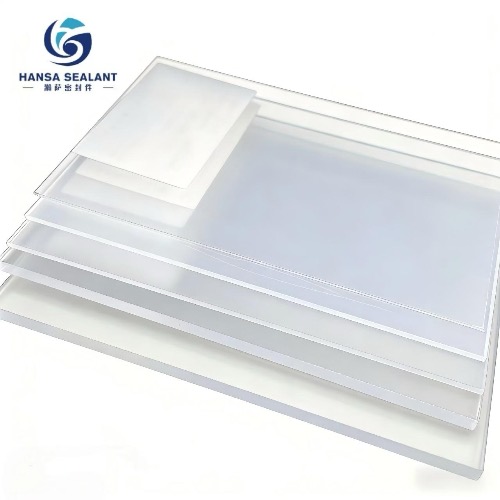
Transparent acrylic sheet, with its unparalleled optical properties, excellent processability, and outstanding weatherability, has become an ideal substitute for glass in numerous fields. With advancements in material science and processing technology, acrylic sheets are evolving from traditional transparent panels into high-performance, multifunctional, and intelligent advanced materials, promising broad application prospects in emerging fields such as high-end displays, green building, and smart home.
Note: The above data is based on industry standards and typical values for high-quality products.


