
Productscpzx

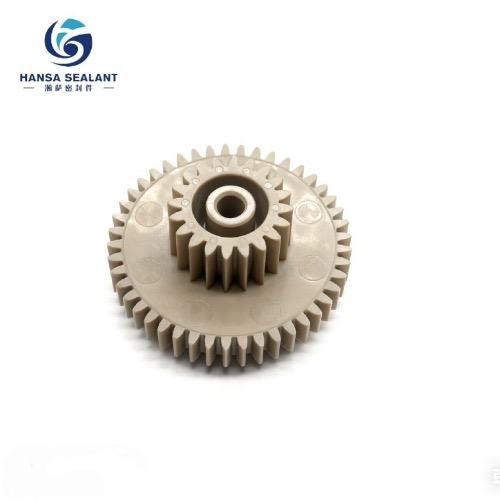
Material Types and Specification Systems
Type
Primary Characteristics
Suitable Gear Types
Color
Density (g/cm³)
Pure PEEK
General-purpose, balanced comprehensive properties
Transmission gears, synchronizer gears
Beige
1.30-1.32
Glass Fiber Reinforced PEEK
Increased stiffness, elevated heat deflection temperature
High-load gears, structural gears
Beige/Black
1.40-1.50
Carbon Fiber Reinforced PEEK
High stiffness, high thermal conductivity, low expansion
Precision gears, high-temperature gears
Black
1.40-1.45
Graphite/PTFE Filled PEEK
Extremely low friction coefficient, self-lubricating
Oil-free lubrication gears, high-speed gears
Black
1.35-1.45
Wear-Resistant Enhanced PEEK
Enhanced wear resistance, extended lifespan
Heavy-duty gears, friction gears
Various
1.35-1.50
Common Specification Ranges
- Module: 0.5-8 mm
- Number of Teeth: 8-200 teeth
- Diameter Range: Φ10 - Φ500 mm
- Thickness Range: 5-100 mm
Technical Parameters and Performance Indicators
Mechanical Properties
| Performance Indicator | Pure PEEK | 30% Glass Fiber Reinforced | 30% Carbon Fiber Reinforced | Test Standard |
| Density (g/cm³) | 1.30-1.32 | 1.49-1.52 | 1.40-1.43 | 1.40-1.43 |
| Tensile Strength (MPa) | 90-100 | 160-180 | 200-220 | ISO 527 |
| Flexural Strength (MPa) | 140-170 | 240-280 | 300-320 | 300-320 |
| Flexural Modulus (GPa) | 3.5-4.0 | 9.0-10.5 | 13-15 | ISO 178 |
| Impact Strength (kJ/m²) | 8-10 | 9-11 | 7-9 | ISO 179 |
| Rockwell Hardness | M99 | M101 | M102 | ISO 2039-2 |
Thermal and Tribological Properties
Performance Indicator
Pure PEEK
30% Glass Fiber Reinforced
30% Carbon Fiber Reinforced
Test Standard
Melting Point (°C)
343
343
343
ISO 3146
Heat Deflection Temp. (1.8MPa, °C)
152
315
315
ISO 75-2
Continuous Service Temperature (°C)
250
250
250
—
Linear Expansion Coefficient (10⁻⁵/K)
4.7
2.4
1.5
ISO 11359-2
Friction Coefficient (vs. Steel)
0.2-0.3
0.25-0.35
0.2-0.3
ASTM D1894
PV Limit Value (MPa·m/s)
3.5
4.5
5.0
—
Gear-Specific Performance
Performance Indicator
Typical Value
Test Conditions
Advantage Description
Bending Fatigue Limit (MPa)
35-45
10⁷ cycles, 23°C
Long lifespan, high reliability.
Contact Fatigue Limit (MPa)
600-800
10⁷ cycles, 23°C
Strong resistance to pitting
Permissible Linear Speed (m/s)
15-25
Continuous operation
Smooth high-speed operation
Noise Level (dB)
Reduced by 3-8
Compared to metal gears
Significant vibration damping and noise reduction.
Transmission Efficiency (%)
98-99.5
ormal lubrication conditions
Low energy consumption, high efficiency
Typical Application Fields
Application Field
Specific Uses
Recommended Type
Key Advantages
Aerospace
Aircraft engine accessory gears, transmission systems, UAV power gears
Carbon Fiber Reinforced PEEK
Lightweight, high-temperature resistant, corrosion resistant.
Automotive Industry
Transmission gears, new energy vehicle motor gears, turbocharger gears
Glass/Carbon Fiber Reinforced PEEK
High-temperature resistant, weight reduction, noise reduction.
Medical Devices
Surgical robot gears, imaging equipment drive gears, infusion pump gears
Pure PEEK/Medical Grade PEEK
Biocompatible, sterilizable, non-magnetic
Food & Beverage
Filling equipment gears, conveyor system gears, food processing machinery gears
Food Grade PEEK
Corrosion resistant, clean, FDA certified.
Semiconductor Manufacturing
Vacuum pump gears, wafer handling gears, etching equipment drive components
High-Purity PEEK
Corrosion resistant, low outgassing, plasma resistant.
Energy & Chemical Industry
Pump & valve gears, compressor gears, deep-sea equipment drive components
Reinforced PEEK Types
Chemical resistant, high-pressure resistant, long service life
High-End Equipment
Precision instrument gears, robot joint gears, textile machinery gears
Various Types
High precision, wear resistant, maintenance-free
Design and Manufacturing Guide
1. Gear Design Key Points
- Module Selection: Recommended module ≥1; consider manufacturing precision for small module gears.
- Tooth Profile Optimization: Involute profile modification can be used to reduce meshing impact.
- Structural Design:Avoid sharp corners, ensure uniform wall thickness, reduce stress concentration.
- Fit Tolerances: Account for thermal expansion differences when fitting with metal shafts; H7/f7 recommended.
2. Manufacturing Processes
| Process Method | Applicable Scenarios | Accuracy Grade | Surface Roughness Ra (μm) | Key Considerations |
|---|---|---|---|---|
| Injection Molding | Mass production, small gears | Grade 7-9 | 0.8-1.6 | Mold temp 160-180°C, sufficient packing pressure. |
| CNC Machining | Small batches, large precision gears | Grade 5-7 | 0.4-0.8 | Sharp tools, adequate cooling, low feed rate. |
| Powder Sintering | Complex structures, special gears | Grade 8-10 | 1.6-3.2 |
3. Post-Processing
- Annealing: Stress relief, 120-140°C for 2-4 hours.
- Surface Treatment: Plasma treatment to increase surface energy; PVD coating if necessary.
- Dimensional Stabilization: Improve dimensional stability through thermal cycling.
Selection Decision Matrix
| Application Scenario | Primary Performance Requirement | Recommended PEEK Type | Design Considerations | Lubrication Suggestion |
|---|---|---|---|---|
| High-Temperature Environment | Temperature resistance, thermal stability | Glass/Carbon Fiber Reinforced | Appropriately increase backlash, consider thermal expansion. | High-temperature grease. |
| Corrosive Environment | Chemical resistance, hydrolysis resistance | Pure PEEK/Special PEEK | Avoid crevice corrosion in design. | Compatible lubricant. |
| High-Speed Operation | Dynamic balance, low friction | Carbon Fiber Reinforced/Graphite Filled | High-precision tooth profile, lightweight design. | Minimal oil mist lubrication. |
| Heavy Load Transmission | High strength, fatigue resistance | Reinforced PEEK Types | Increase face width, optimize root fillet. | Heavy-duty grease. |
| Clean Environment | Low outgassing, easy cleaning | Pure PEEK/Medical Grade | Smooth surfaces, no dead-end design. | Solid lubricants / Dry running. |
| Precision Transmission | Dimensional stability, low backlash | Carbon Fiber Reinforced PEEK | Tight tolerance fits, eliminate play. | Precision instrument oil. |
| Underwater Application | Hydrolysis resistance, biofouling resistance | Special PEEK Types | Corrosion-resistant design, avoid electrochemical corrosion. | Waterproof grease. |
Industry-Specific Custom Solutions
1. Aerospace Sector
- Requirements: Extreme environment adaptability, high reliability, lightweight.
- Solution: Carbon fiber reinforced PEEK gears, vacuum-grade purity, temperature resistant to 300°C.
- Applications:Engine auxiliary gears, spacecraft transmission systems, UAV power gears.
2. Medical Robotics Sector
- Requirements: Repeatedly sterilizable, high precision, biocompatible.
- Solution: Medical-grade PEEK gears, compatible with gamma-ray sterilization, nano-level precision.
- Applications: Surgical robot joint gears, rehabilitation equipment drives, diagnostic instrument gears.
3. New Energy Vehicle E-Drive Systems
- Requirements: High-temperature resistance, weight & noise reduction, fluid resistance.
- Solution: Reinforced PEEK gears, NVH-optimized design, resistant to transmission oil.
- Applications: Motor reduction gears, oil pump gears, transmission auxiliary gears.
4. Semicnductor Manufacturing Equipment
- Requirements: Ultra-high cleanliness, plasma resistance, low outgassing.
- Solution: Ultra-high purity PEEK gears, special surface treatment, vacuum compatible.
- Applications: Vacuum pump gears, wafer handling gears, etching equipment drives.
5. Deep-Sea Exploration Equipment
- Requirements: High-pressure resistance, seawater corrosion resistance, long service life.
- Solution: Reinforced PEEK gears, pressure-resistant design, seawater corrosion protection.
- Applications: ROV drive gears, deep-sea pump gears, exploration equipment drive components.
Installation and Maintenance Guide
Installation Precautions
1. Assembly Environment: Perform in a cleanroom to avoid contamination.
2. Temperature Acclimatization: Allow gears to equilibrate to working environment temperature for 24 hours before assembly.
3. Assembly Method: Press in uniformly, avoid impact loads; heating-assisted assembly is recommended.
4. Fastening Method: Avoid over-tightening; use a torque wrench for control.
5. Alignment Accuracy: Ensure shaft alignment accuracy <0.05mm.


