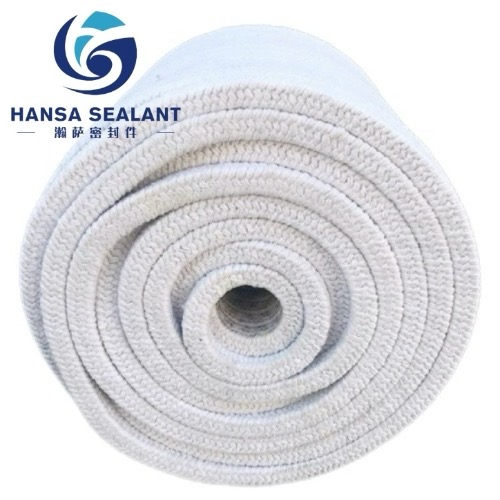
Brief Introduction to Ceramic Fiber Packing
Ceramic fiber packing is a high-performance sealing material primarily made from inorganic ceramic fibers, offering outstanding resistance to high temperatures, corrosion, and thermal insulation. Through specialized braiding processes and impregnation treatments, it maintains stable sealing effectiveness in extreme environments above 1000°C for extended periods. It is widely used in critical equipment sealing within industrial sectors such as petroleum and chemical, metallurgy, and power generation.
Core Characteristics
- Exceptional Temperature Resistance: Long-term tolerance of 1000-1400°C, short-term tolerance up to 1600°C.
- Excellent Chemical Stability: Resistant to acid and alkali corrosion (except hydrofluoric acid).
- Low Thermal Conductivity: Effectively reduces heat transfer, saving energy and lowering consumption.
- Good Compression Resilience: Maintains sealing reliability under pressure changes.
- Environmentally Safe: Contains no harmful substances like asbestos.
Typical Applications
- High-temperature valve and pump body seals.
- Industrial kiln and heating equipment seals.
- Chemical pipeline flange seals.
- Aerospace engine sealing systems.
Development Trends
As industrial equipment evolves towards higher temperatures and pressures, ceramic fiber packing is continuously innovating in directions such as higher temperature tolerance (above 1500°C), longer service life, and intelligent monitoring. It has become an indispensable key sealing material in modern industry.
Ceramic Fiber Packing Performance Parameters Table
| Performance Indicator |
Parameter Range |
Test Standard |
Remarks |
| Temperature Resistance Range |
-50°C ~ 1400°C |
ASTM D4102 |
Long-term use temperature: 1000°C |
| Tensile Strength |
8-15 MPa |
ASTM D5035 |
Varies based on fiber composition |
| Compression Rate |
15-25% |
ASTM F36 |
Measured at 5 MPa pressure |
| Rebound Rate |
≥ 30% |
ASTM F1314 |
Recovery ability after load release |
| Thermal Conductivity |
0.1-0.2 W/(m·K) |
ASTM C518 |
Measured at room temperature |
| Density |
1.8-2.2 g/cm³ |
ASTM D792 |
Can be customized and adjusted |
| pH Tolerance Range |
2-12 |
ASTM D543 |
Except hydrofluoric acid |
| Friction Coefficient |
0.08-0.15 |
ASTM D1894 |
Lower after graphite impregnation |
Ceramic Fiber Packing Product Specifications Table
| Model |
Diameter (mm) |
Operating Temperature (°C) |
Main Components |
Suitable Media |
| CFW-100 |
CFW-100 |
CFW-100 |
Aluminosilicate Fiber + Graphite |
Steam, Hot Oil |
| CFW-200 |
5-60 |
-50 ~ 1200 |
-50 ~ 1200 |
Molten Salt, Alkaline Solution |
| CFW-300 |
6-80 |
-50 ~ 1400 |
High-Purity Alumina Fiber |
High-Temp Gas, Molten Metal |
| CFW-400 |
4-40 |
-50 ~ 1100 |
Ceramic Fiber + PTFE |
Ceramic Fiber + PTFE |
Ceramic Fiber Packing vs. Traditional Sealing Materials Comparison Table
| Comparison Item |
Ceramic Fiber Packing |
Graphite Packing |
Aramid Packing |
Aramid Packing |
| Max. Temp. Resistance |
1400°C |
600°C |
300°C |
500°C |
| Corrosion Resistance |
Excellent |
Good |
Fair |
Poor |
| Service Life |
2-5 years |
1-3 years |
6-18 months |
6-12 months |
| Environmental Friendliness |
Non-polluting |
Non-polluting |
Non-polluting |
Contains carcinogens |
| Cost |
Relatively High |
Moderate |
Moderate |
Low |
Ceramic Fiber Packing Selection Reference Table
| Operating Condition |
Recommended Model |
Recommended Model |
| Temperature ≤ 1000°C, General Media |
CFW-100 |
Standard type, economical and practical |
| Temperature ≤ 1400°C, Oxidizing Environment |
CFW-300 |
Requires anti-oxidation coating |
| Strong Acid Corrosive Media (pH ≤ 3) |
CFW-400 |
Avoid use in hydrofluoric acid environment |
| High-Pressure High-Speed Rotary Seals |
CFW-200 |
Requires metal reinforcement layer |
| Ultra-High Temperature Intermittent Operation |
CFW-300 |
Recommended preload increase by 10-15% |